What Hidden Costs Come With a Backyard Putting Green?
Putting green quotes often cover the green surface itself but not the features that make it fully functional and visually integrated.
Fringe Area
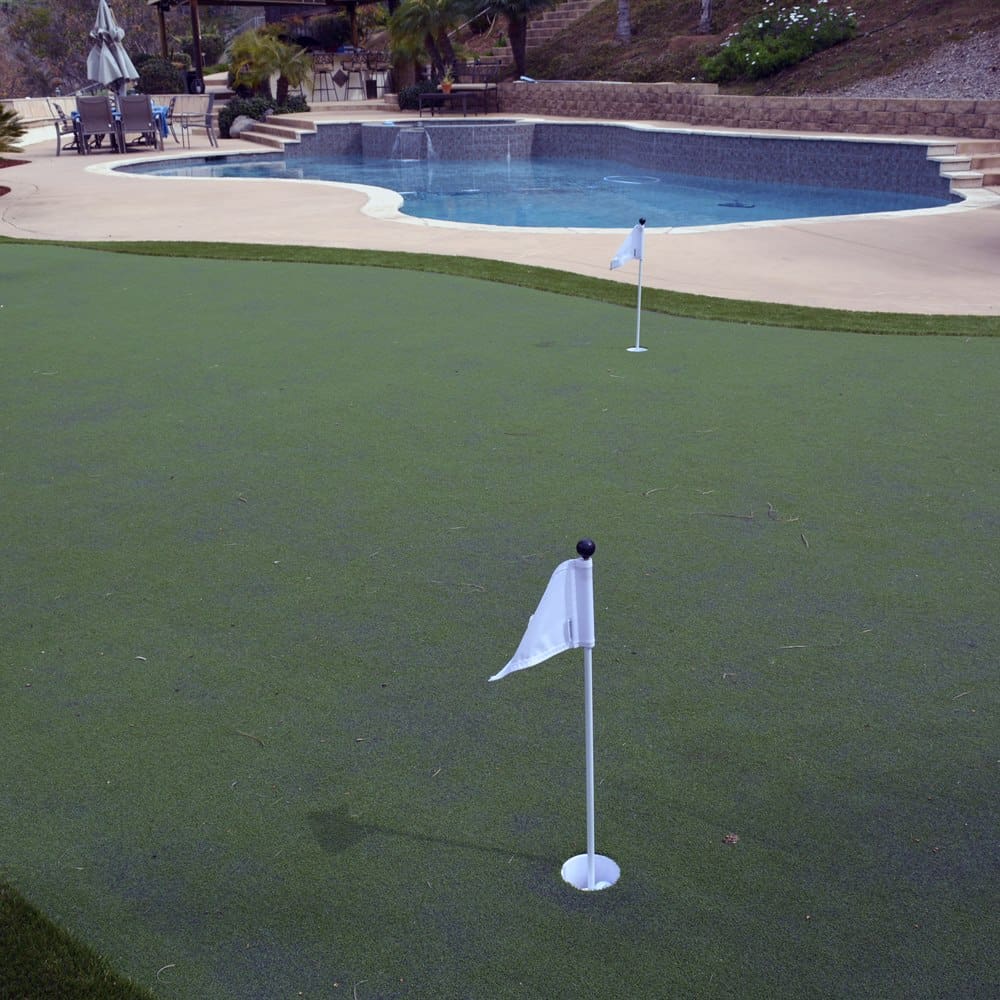
The fringe — a 2 to 4-foot band of slightly longer turf surrounding the putting surface — is often quoted separately from the green itself. Without the fringe: the green transitions directly to whatever surrounds it (mulch, natural grass, pavers). The fringe creates the visual and functional boundary of the green and allows chipping practice from the fringe area onto the green. Fringe turf at $10 to $15 per square foot for a 2-foot band around a 300-square-foot green (approximately 80 linear feet x 2 feet = 160 square feet): adds $1,600 to $2,400. This is a significant addition that may not be included in the initial green quote.
Collar Lighting for Evening Play
LED lighting installed along the perimeter or within the green surface allows evening putting practice — a high-value feature for golfers whose available practice time falls after work. Perimeter LED collars: $1,000 to $3,000 depending on the run length. In-surface lighting: $2,000 to $5,000. The electrical work (running a circuit to the green and installing the fixtures): $500 to $1,500 additional from an electrician. Lighting is an add-on feature that dramatically extends the usable hours of a putting green but is rarely included in a base quote. (For more on this, see What Makes a Good Backyard Putting Green?.)
Sand Traps and Bunkers
A sand trap adjacent to the green provides bunker practice — the other major short-game skill that determines scoring performance. A simple sand trap: $1,500 to $2,000 for excavation, edging, and the correct bunker sand. A larger practice bunker with a shaped face: $2,000 to $3,000. The sand trap must be edged with a material that prevents sand migration onto the turf (which would damage the turf surface). Bunker sand (a specific angular silica sand appropriate for bunker play, not general construction sand): $100 to $300 for a small practice bunker.
Surrounding Landscape Integration
The putting green exists within the surrounding landscape — and the transition from the green to the adjacent space must look intentional. Plants, mulch beds, or hardscape bordering the green should be planned and installed as part of the overall project. If a sprinkler system serves the surrounding natural lawn: the sprinkler heads must be adjusted to clear the green (water on the putting surface affects ball roll and may damage the backing). These landscape adjustments: $500 to $3,000 depending on the extent. (For more on this, see How Much Does a Backyard Putting Green Cost?.)
Putting Green Cost at a Glance
Putting green turf: $3 to $9 per square foot for the material alone — specialized short-pile turf, with nylon at the top of the range and polypropylene at the bottom.
Base and installation: $12 to $32 per square foot — grading, base, cups, and contouring, and the larger half of the installed price.
Custom features: Added cost — multiple cups, sand traps, fringe, and lighting.
Overall range: $18 to $40 per square foot installed, averaging $27 per square foot. Greens under 400 square feet run $30 to $35, 400 to 2,000 square feet $25 to $30, and over 2,000 square feet $20 to $25.
Planning Your Project Budget
The cost ranges in this article are based on industry data and are intended as planning benchmarks, not fixed prices. The actual cost for your project depends on your specific home, your local labor market, the current price of materials, and the scope the contractor confirms after a site inspection.
Always get at least two written quotes on equivalent defined scope before committing to any home services project. Wide price variation between quotes usually reflects differences in material quality, scope completeness (what is included and what is not), or contractor overhead and experience level rather than simple price competition.
Use the cost data in this article to ask better questions during the quoting process: What material is included? What does that per-square-foot or per-linear-foot rate include and exclude? Are permits, cleanup, and disposal included? What is the warranty on labor? These questions turn a quote into a comparable basis for decision-making.
Working With a Contractor on This Project
Getting the right outcome on any home services project starts before the work begins. A few consistent practices make the difference between a smooth project and a frustrating one.
Get at least two or three quotes. A single quote gives you no basis for comparison. Two or three quotes reveal the market rate for the work, expose scope differences between bidders, and let you assess contractor communication quality before any commitment is made. The lowest bid is not automatically the best value if the scope is thin or the materials are underspecified.
Ask for licenses and insurance before work starts. Verify current general liability insurance and, for any work involving workers on your property, workers compensation coverage. Licensing requirements vary by state and trade; confirm the specific requirements in your jurisdiction. A licensed contractor who carries appropriate insurance protects both parties if something goes wrong during the project.
Get the scope in writing. A written proposal that specifies materials, labor scope, timeline, what is included (permits, cleanup, disposal), and warranty terms is the foundation of a professional engagement. Verbal agreements on any of these points invite misunderstanding. For any project over $500, written scope is non-negotiable.
Clarify the payment schedule upfront. A reasonable payment schedule ties major payments to project milestones: a deposit at signing, a payment at material delivery or project start, and a final payment at completion after a walkthrough confirms satisfaction. A contractor who requires full payment upfront before work begins is a red flag in any trade.
Cost figures on this page were checked against published pricing on September 2, 2026. How we source cost data.