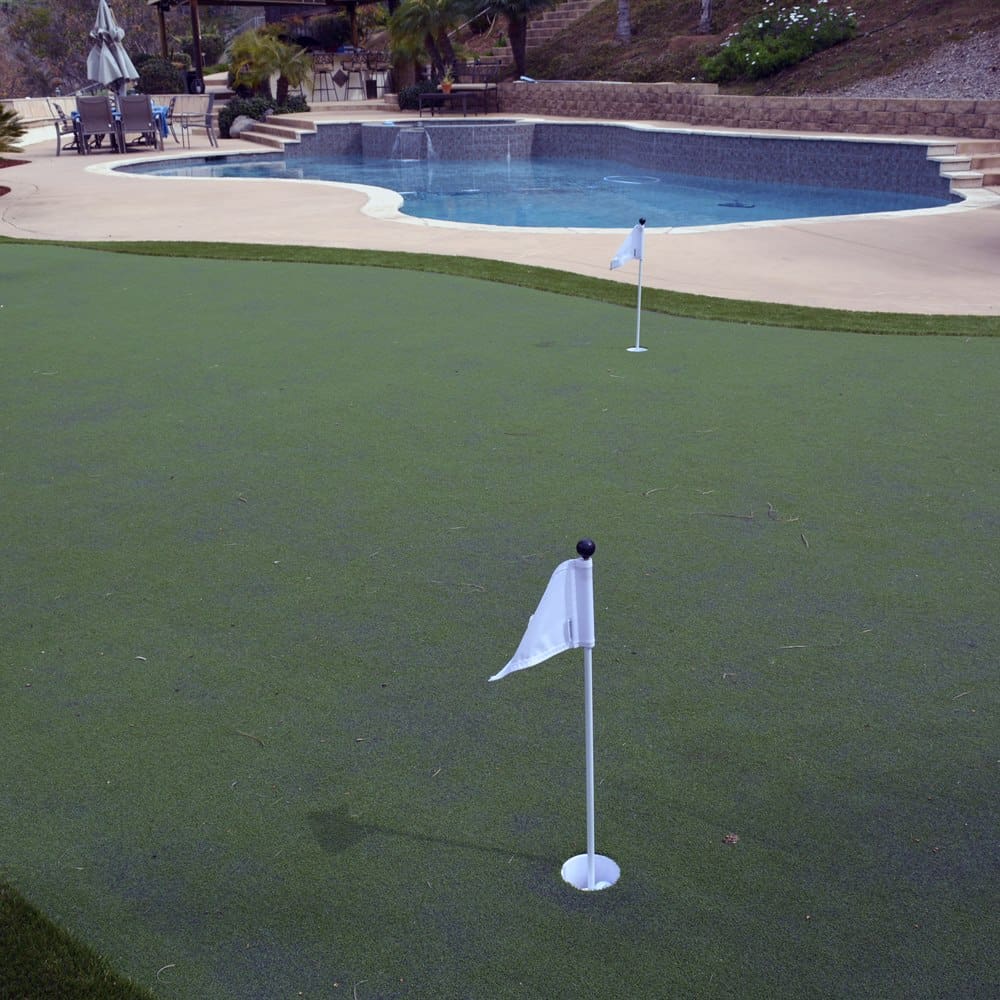
What Are the Downsides of a Backyard Putting Green?
A backyard putting green gives an avid golfer unlimited short-game practice at home, and for the right person, that’s genuinely valuable. That’s the honest verdict. But a putting green has real trade-offs worth understanding before you build one. Here’s the candid look.
It Costs More Than a Lawn
A putting green costs more per square foot than regular turf, $18 to $40 versus $10 to $17 for a lawn, because of the specialized turf, precision base work, cups, and contouring. For a golfer who’ll use it constantly, the cost is justified by the practice value; for a casual dabbler, it’s a significant investment for occasional use. The specialized nature that makes it a real green is exactly what makes it cost more. Be honest about how much you’ll use it before investing. The specialized turf is the single biggest reason for the premium: a putting surface uses a short, dense, high-face-weight pile engineered for true ball roll rather than the taller, softer fiber of a lawn, and that performance turf, combined with the precision base and cup-and-contour work, is simply more material and more skilled labor per square foot than a decorative lawn requires. The math is really about frequency of use, spread across years of regular practice a green’s cost per session becomes trivial, but concentrated into a handful of uses a year it stays expensive per round of putting, so the same green can be an excellent value or a poor one depending entirely on how often you’ll actually walk out and use it. (For more on this, see What Makes a Putting Green Cost More (or Less)?.)
It Takes Dedicated Space
A putting green occupies a portion of your yard permanently, and a green large enough to be interesting (with some length and contour) takes real space. In a small yard, a meaningful green may consume most of it, leaving little for other uses. Consider whether the space a good green requires fits your yard and your other needs for it. The space commitment is a real consideration, especially in a smaller yard. The tension is that the very things that make a green interesting, some length for longer putts and room for a couple of breaks, are what consume the space, so a green shrunk to fit a tight yard can end up too small and flat to be engaging, which is part of why a small yard sometimes argues for a portable option over a permanent green that won’t have room to be good. There’s a genuine tension between size and interest here, a green needs some length and a few contours to be worth practicing on, but those same qualities are what make it consume yard, so in a compact lot you often face a real choice between a green large enough to be engaging and preserving space for seating, play, or planting. (For more on this, see When a Backyard Putting Green Isn’t the Right Choice.)
It Still Needs Maintenance
A putting green is lower-maintenance than natural grass but not maintenance-free. It needs periodic brushing to keep the pile upright, infill leveling and occasional replenishment to maintain green speed, and clearing of debris. For serious golfers wanting to maintain precise speed, the green needs regular grooming. This is modest compared to a real grass green, but a putting green isn’t zero-upkeep. Expect light, regular grooming to keep it playing well. The grooming directly protects playability rather than just appearance: brushing stands the short fibers back upright so the roll stays true, and topping up and leveling the fine infill maintains the green speed you paid to dial in, so a neglected green doesn’t just look tired, it gradually loses the consistent, fast roll that was the whole point of building it. The grooming directly protects playability rather than just appearance, brushing stands the pile back up so the ball rolls true, and periodically leveling and topping up the fine infill maintains the green speed, so unlike a purely decorative lawn, a putting green’s upkeep is tied to how well it performs, which is why golfers serious about consistent speed keep after it.
Its Appeal Is Specialized
A putting green is built for golfers, and to a non-golfer, or a buyer who doesn’t play, it may hold little appeal, some might even see it as space to convert back. This is fine if you’re building it to use, that’s the point, but don’t assume it adds broad resale value; its appeal is to golf-loving buyers specifically. If broad resale matters, that’s a consideration. For its intended purpose, though, resale isn’t the point. It’s worth being clear-eyed that a putting green is a personal-use amenity first, its value is the practice and enjoyment it gives you while you own the home, and any resale benefit is a bonus that depends entirely on the next buyer sharing your interest, so the honest way to justify one is by how much you’ll use it, not by expecting it to pay back at sale. It’s worth being clear-eyed that a green is a personal amenity built for your enjoyment, not a broadly value-adding renovation like a kitchen or bath, so the right frame is whether the years of practice and pleasure justify the cost to you, treating any appeal to a future golfing buyer as a bonus rather than a reason to build.
It Can Get Hot (Like Any Turf)
Like all artificial turf, a putting green absorbs heat and can get hot in direct summer sun. This affects comfort during play on the hottest days, though it doesn’t stop you from putting. Lighter turf and rinsing help. It’s a minor consideration for a putting surface (you’re not lying on it), but worth knowing, like any turf, it warms in the sun. The effect is milder in practice for a green than for a lawn you might sit or play on, since you’re standing and walking on a putting surface rather than lying on it, but on a fully sun-exposed green the surface can still warm noticeably on a hot afternoon, and a quick rinse cools it if you’re playing barefoot or the heat starts to bother you. Because you’re standing and walking on a green rather than lying or sitting on it, the heat is far less of an issue than it would be on a lounging lawn, and the usual mitigations, lighter-colored turf and a quick rinse before a hot-afternoon session, are generally enough to keep it comfortable underfoot for putting.
Is It Still Worth It?
For an avid golfer who’ll practice regularly, a backyard putting green is often very worth it, the convenience of unlimited short-game practice at home is a real benefit, and a quality green is a genuine amenity. The drawbacks are about deciding wisely: it costs more than a lawn, takes dedicated space, needs light grooming, appeals mainly to golfers, and warms in the sun. Weighed honestly, for someone who’ll use it, a putting green is an excellent backyard investment. When you’re ready to explore it, connect with local pros below. (For more on this, see Common Backyard Putting Green Mistakes and How to Avoid Them.)
Cost figures on this page were checked against published pricing on August 29, 2026. How we source cost data.
Frequently Asked Questions
It costs more than a lawn, $10 to $25 per square foot versus $6 to $20, because of the specialized turf, precision base work, cups, and contouring. For a golfer who'll use it constantly, the cost is justified; for a casual dabbler, it's a significant investment for occasional use. Be honest about how much you'll use it.
It takes dedicated space permanently, and a green large enough to be interesting (with length and contour) needs real room. In a small yard, a meaningful green may consume most of it. Consider whether the space a good green requires fits your yard and your other needs for it.
Some, though less than natural grass. It needs periodic brushing to keep the pile upright, infill leveling and occasional replenishment to maintain green speed, and debris clearing. Serious golfers wanting precise speed need regular grooming. Modest compared to a real grass green, but not zero-upkeep.
Its appeal is specialized, built for golfers, so to a non-golfer or a buyer who doesn't play it may hold little appeal. If you're building it to use, that's the point; just don't assume broad resale value. Its appeal is to golf-loving buyers specifically. For its intended purpose, resale isn't the point.
Like any artificial turf, it absorbs heat and can get hot in direct summer sun, affecting comfort on the hottest days, though it doesn't stop you putting. Lighter turf and rinsing help. It's a minor consideration for a putting surface since you're not lying on it, but worth knowing.