
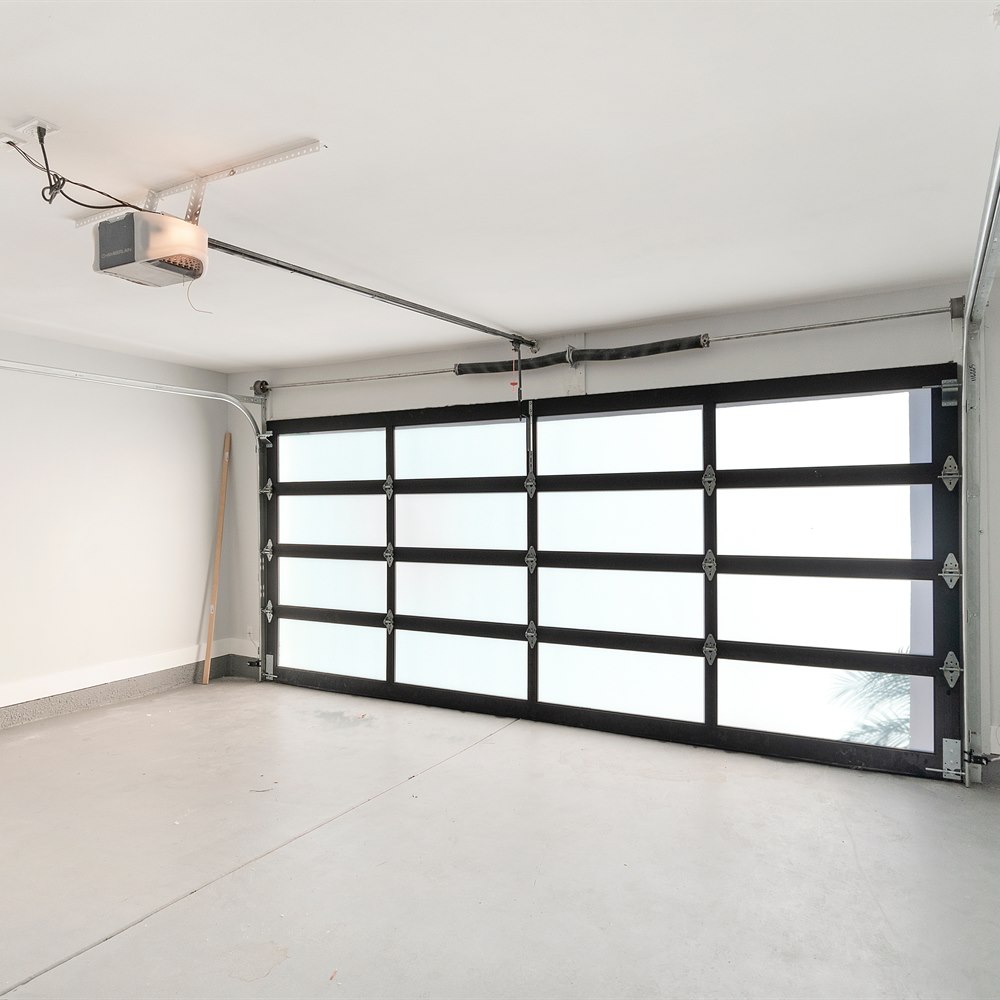
How Do You Choose the Best Garage Door Opener?
The best garage door opener is the one matched to your door’s weight, your garage’s noise tolerance, your household’s connectivity needs, and your budget. Four decisions cover almost all of it: drive type, horsepower, smart features, and brand. Get those right and a properly installed opener serves reliably for 10 to 15 years.
Before you start comparing models, decide your priority order. Is upfront cost the dominant factor, or quiet operation, or long-term low maintenance, or connectivity? Different priorities lead to different right answers on drive type, power, and feature set, and clarifying yours before you are in a sales conversation produces a better decision than discovering them mid-negotiation.
Drive Type Is the Decision You Live With Daily
Drive type determines operating noise, which is the characteristic most likely to affect your daily experience. It matters more than any other single choice for long-term satisfaction.
Belt drive: the right choice for attached garages, particularly those with bedrooms or living space above or adjacent. It operates significantly more quietly than a chain drive, and the $100 to $200 premium is justified by the daily noise reduction. (For more on this, see Chain-Drive vs. Belt-Drive vs. Smart Opener: Which Is Best?.)
Chain drive: the practical and economical choice for detached garages, or anywhere operating noise does not reach living space. Reliable, mechanically durable, and the lowest cost of the three.
Screw drive: a middle ground. Quieter than a chain drive with fewer moving parts than a belt drive.
Match Horsepower to Door Weight
Motor power is the most technically important specification, and an under-powered opener wears faster and operates poorly.
1/2 HP: adequate for standard single-layer steel doors on a single-car opening.
3/4 HP: the right level for insulated doors, heavy two-car doors, and solid wood or carriage-house doors, which it handles without straining.
1 to 1-1/4 HP: for very heavy or specialty doors.
When you are uncertain about door weight, choose the next power level up. Over-sizing slightly gives the motor a margin against strain and extends service life. The cost difference between 1/2 and 3/4 horsepower is typically about $50, which is usually worth paying for any door at the heavy end of what 1/2 horsepower can handle.
Buy Only the Smart Features You Will Use
Smart features add genuine value when you will use them daily and add nothing when you will not. Decide which ones apply to your household before paying the $100 to $250 smart premium.
App control and remote monitoring: the most universally useful feature. Many homeowners check garage door status multiple times a day, and being able to do it from anywhere is a real convenience.
Built-in camera: adds security monitoring, and is most useful for households with frequent deliveries or anyone who travels and wants to verify access.
Activity notifications: worth having in multi-user households where you want to know when the door opened and who opened it.
Battery backup: valuable in areas with frequent power outages, or for households where manually lifting the door is inconvenient.
Voice assistant integration: Alexa, Google, and HomeKit compatibility is worth paying for only if you already use those platforms actively.
If your existing opener is less than 10 years old and running reliably, an aftermarket smart module at $30 to $80 adds basic app control without a full replacement. Replacing the whole unit for smart features makes the most sense when the opener is also aging out.
Brand, Service Network, and Spring Timing
LiftMaster is the contractor-grade brand and the most widely installed professional opener. Chamberlain is its consumer equivalent from the same parent company, and Genie is the other established name. These three have the best reliability records, warranty support, and parts availability.
Beyond the brand name, check the local service network. Over a 10 to 15-year service life you may need programming support, replacement remotes, sensor replacement, or warranty service. A brand serviced by established local companies gives you far better long-term support than one backed only by a manufacturer’s call center. Ask potential installers which brands they service and support before you settle on one. (For more on this, see Questions to Ask Before Buying a Garage Door Opener.)
If your door springs are standard cycle and more than five or six years old, replace them at the same time as the opener. Combining both into a single service visit saves a separate service call fee, and the new opener starts out matched to a complete, reset system. (For more on this, see How Much Does a Garage Door Opener Cost?.)
Verify the Installer Before You Commit
Verify the contractor’s current license status with your state licensing board, which usually has an online lookup tool. Request a current certificate of general liability insurance naming you as an additional insured for the duration of the project, and confirm workers’ compensation coverage for any employees. These checks take about 15 minutes and protect you from the financial liability of an uninsured worker injured on your property. Legitimate contractors provide the documents without hesitation.
How a contractor handles your questions before the job predicts how they will handle problems during it. One who answers specifically, follows up when they say they will, and provides a written proposal without repeated prompting is showing you the professionalism they will bring to a mid-project problem. One who is evasive about qualifications or pressures you toward a quick decision is showing you that too. Get quotes on equivalent scope, confirm what is included in writing, and choose on demonstrated competence rather than the lowest opening number.
Cost figures on this page were checked against published pricing on August 30, 2026. How we source cost data.
Frequently Asked Questions
Match motor power to door weight (1/2 HP for standard single-layer steel, 3/4 HP for insulated, heavy two-car, or wooden doors). Choose drive type for noise tolerance: belt for attached garages, chain for detached. Select smart features only for use cases you will actually use, and choose an established brand such as LiftMaster, Chamberlain, or Genie.
1/2 HP for most standard single-car steel doors, 3/4 HP for two-car doors, heavily insulated doors, solid wood doors, or carriage-house styles, and 1 to 1-1/4 HP for very heavy or specialty doors. When in doubt choose the higher horsepower: the difference is $50 to $100 and it gives the motor margin against strain that extends service life.
Belt for an attached garage next to bedrooms or living areas, where the significantly quieter operation justifies the $100 to $200 premium. Chain for a detached garage, where it is reliable, economical, and mechanically durable and the noise does not reach living space. Screw drive is the middle ground, quieter than chain with fewer moving parts than belt.
App control for remote monitoring and status checking is the most universally valuable. A built-in camera is worth it for security monitoring and frequent deliveries, battery backup for areas with frequent power outages, and activity notifications for multi-user households. Voice assistant integration is worth paying for only if you already use Alexa, Google, or HomeKit actively.
LiftMaster is the contractor-grade brand and the most widely installed professional opener. Chamberlain is its consumer equivalent from the same parent company, and Genie is another established name. Any of these, matched to the door weight and professionally installed, produces a reliable 10 to 15-year system.
Not necessarily. If the existing opener is less than 10 years old and functioning reliably, an aftermarket smart module at $30 to $80 adds basic app control without a full replacement. Full replacement for smart features makes the most sense when the opener is also aging and approaching the end of its service life.
Yes, if the springs are standard cycle and more than five or six years old. Combining both into one service visit saves a separate service call fee, and the new opener starts out matched to a complete, reset system.
Check their current license status with your state licensing board's online lookup, request a certificate of general liability insurance naming you as an additional insured for the project, and confirm workers' compensation coverage for employees. The checks take about 15 minutes, and legitimate contractors provide the documents without hesitation.