
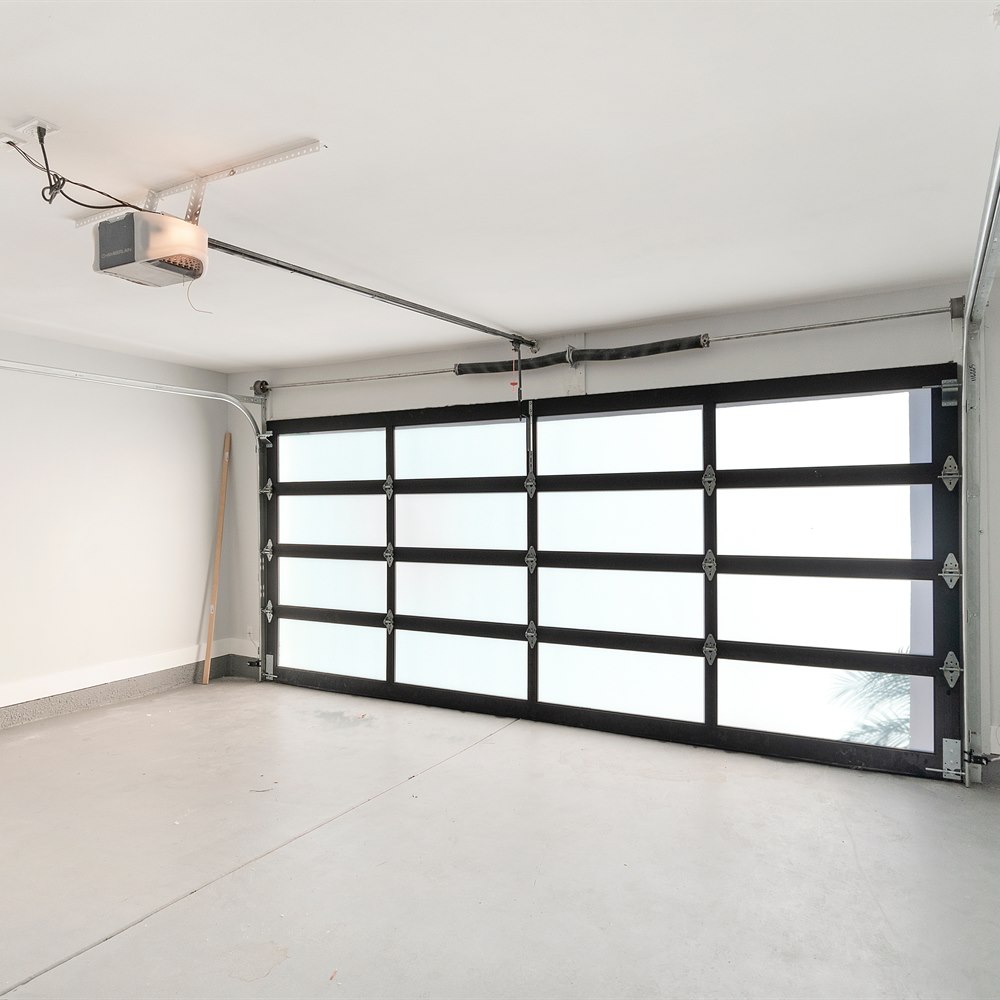
Which Garage Door Opener Is Best?
Chain-drive openers run $325 to $550 installed, belt-drive $350 to $600 and 10 to 15 decibels quieter, and smart openers $600 to $1,200. Smart is not a separate drive mechanism: smart garage door openers pair connectivity with either a chain or a belt drive. The right choice depends less on which type is objectively best than on whether your garage is attached, how often you use the door, and whether you want to control it from your phone.
How the Three Main Options Compare
Chain-Drive: Most Economical, Most Noise
Chain-drive: $325 to $550 installed. The most economical, most widely sold, and most mechanically durable option. Chain drives are reliable and straightforward, with a metal chain pulling the trolley along the rail.
The trade-off is noise. The chain mechanism produces vibration and rattling that travels through the structure. In a detached garage, where that noise never reaches living space, the trade-off is largely irrelevant and a chain drive is the clear practical choice. In an attached garage, particularly one beneath or adjacent to bedrooms, it is noticeable and disruptive. Chain drives also need occasional lubrication that belt drives do not.
Belt-Drive: Quieter for a Modest Premium
Belt-drive: $350 to $600 installed. A rubber or polyurethane belt drives the trolley, eliminating most of the chain drive’s noise and vibration. Belt openers run roughly 10 to 15 decibels quieter than chain, a difference most homeowners notice immediately in an attached garage.
Modern belt drives match chain drives on reliability and durability, and they require no lubrication. The modest premium over a comparable chain drive is well spent on any attached garage application. Belt-drive is the most popular choice for attached garages and the best overall balance of quiet operation, reliability, and cost for most homeowners.
Smart Opener: Connected Features at a Premium
Smart opener: $600 to $1,200 installed. Smart models add app-based remote operation, activity notifications, a built-in camera for visual confirmation, smart home integration, and battery backup that keeps the door working during a power outage. The underlying chain or belt mechanism still does the physical work; the connectivity adds convenience and security on top. (For more on this, see Chain vs. Belt vs. Smart Garage Door Opener: Which Is Right?.)
Smart models carry a premium above a comparable belt-drive opener. That is money well spent for households that manage frequent deliveries, need to let service providers in remotely, travel often enough to want status monitoring, or lose power regularly. If app control would go unused after the first month, a standard belt drive delivers the same quiet, reliable operation for less.
Two Drive Types Worth Knowing About
Screw-Drive
A screw-drive opener uses a rotating steel rod to move the trolley. It has fewer moving parts than a chain or belt drive and needs less maintenance, and it falls in the mid-price range between chain and belt. Screw drives are more sensitive to temperature swings than belt drives, which makes them less common in extreme-climate regions. (For more on this, see Garage Door Opener Upgrade: When It Makes Sense.)
Wall-Mount (Jackshaft)
A wall-mount opener installs beside the garage door rather than overhead, eliminating the ceiling rail entirely. That preserves overhead storage space, allows high-lift door configurations, and is typically quieter than an overhead-rail system. Wall-mount openers run $800 to $950 installed and are the right answer when ceiling space is limited or the door configuration requires it.
Adding Smart Features Without Replacing the Opener
You do not need a new opener to get app control. Add-on smart controllers such as Chamberlain myQ add app control and activity notifications to a compatible existing opener for about $65, and aftermarket smart modules generally run $30 to $80. They work with most openers manufactured after 1993, the year the safety reversal requirement was standardized, and a module is far less expensive than replacing a working opener for smart features alone.
What a module cannot add is hardware: battery backup and an integrated camera require an opener with those features built in. Most smart openers integrate with Amazon Alexa, Google Home, and Apple HomeKit, though support varies by brand. LiftMaster and Chamberlain use the myQ platform, which works with most major smart home systems. Confirm the specific integrations for any opener you are considering rather than assuming.
Making the Choice
Choose chain-drive for a detached garage, or any application where cost is the priority and noise is not a concern. Choose belt-drive for an attached garage or anywhere quiet operation affects daily living comfort. Choose a smart opener when remote monitoring, app control, or battery backup answer a genuine daily use case, and remember that any drive type can be paired with an aftermarket module later if you decide you want connectivity without a full replacement. (For more on this, see How Much Does a Garage Door Opener Cost?.)
Before You Approve an Installer
Verify the installer’s current license status with your state licensing board, which usually offers an online lookup tool. Request a current certificate of general liability insurance naming you as an additional insured for the duration of the project, and confirm workers’ compensation coverage for any employees. These checks take about 15 minutes and protect you from liability if an uninsured worker is injured on your property. Legitimate contractors provide the documents without hesitation. Get site-visit quotes on the same defined scope so the numbers are comparable, and treat how a contractor handles your questions before the job as a preview of how they will handle problems during it.
Cost figures on this page were checked against published pricing on September 2, 2026. How we source cost data.
Frequently Asked Questions
Chain-drive uses a metal chain: the most economical option at $325 to $550 installed, durable, but noisier. Belt-drive uses a rubber belt and runs quieter for $350 to $600. For detached garages, chain-drive provides excellent value; for attached garages next to living space, the modest belt premium is usually worth it.
Typically 10 to 15 decibels quieter. The difference is significant in an attached garage where sound transmits into adjacent rooms, and most homeowners who switch from chain to belt notice an immediate improvement.
It is worth the $600 to $1,200 when the features match real use cases: remote access for service providers or deliveries, travel monitoring, smart home integration, or power outage resilience through battery backup. If app control would rarely be used, a belt-drive opener gives you the same quiet operation without the smart premium.
Yes. Add-on smart controllers such as Chamberlain myQ run about $65, and aftermarket smart modules generally run $30 to $80. They work with most openers made after 1993 and add app control and activity notifications. Battery backup and a built-in camera require a new opener with that hardware.
Most smart openers integrate with Amazon Alexa, Google Home, and Apple HomeKit, though support varies by brand. LiftMaster and Chamberlain use the myQ platform, which works with most major smart home systems. Confirm the specific integrations for the opener you are considering.
A third drive type that uses a rotating steel rod to move the trolley. Screw drives have fewer moving parts and need less maintenance than chain or belt drives, and they sit in the mid-price range between the two. They are more sensitive to temperature changes, so they are less common in extreme climates.
A wall-mount opener installs beside the door instead of overhead, removing the ceiling rail. It preserves overhead storage, supports high-lift door configurations, and is typically quieter than an overhead-rail system. Expect $800 to $950 installed.
Chain and belt drives are equally reliable when properly maintained. Chain drives are mechanically simple and need occasional lubrication; modern belt drives match their durability and need none. Reliability depends more on installation quality and door balance than on drive type.