
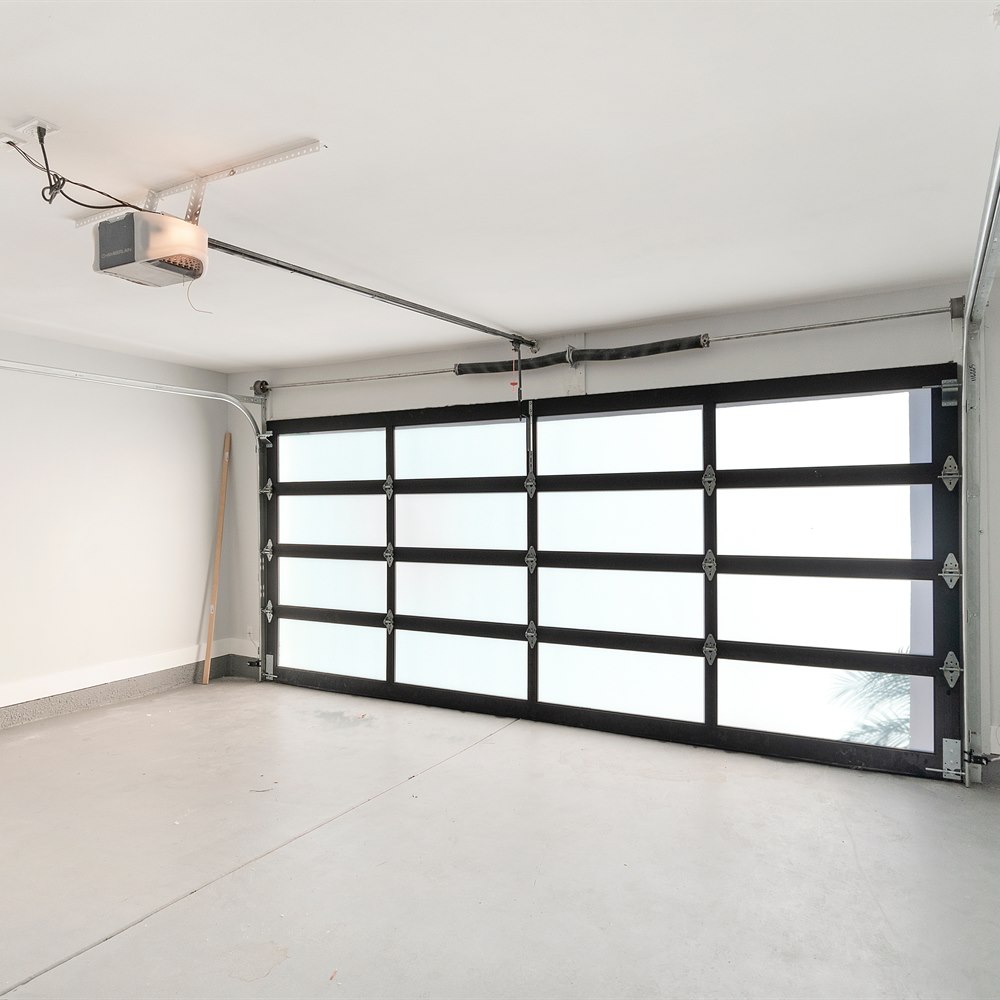
What Drives Garage Door Opener Costs?
A garage door opener costs $325 to $1,200 installed. The number is driven by the drive mechanism, the smart feature level, motor power relative to your door’s weight, what the installation requires, and the accessories you add. Here is what moves it.
Drive Type
Drive type is the most direct cost driver, and the right choice follows noise tolerance more than anything else. Chain-drive is the most economical at $325 to $550 installed and is a sensible pick for a detached garage. Belt-drive runs $350 to $600, a modest step up from chain, and is the standard recommendation for an attached garage where the opener sits below a bedroom or beside living space. Screw-drive units use a rotating threaded steel rod, fall in the mid-range, need less maintenance than a chain, and are more temperature-sensitive. Direct-drive openers at $550 to $850 installed move the motor itself along the rail with only one moving part, making them the quietest type, though they are less widely available. Wall-mount openers at $800 to $950 mount beside the door and eliminate the overhead rail entirely, which is the answer when ceiling space is limited or the door uses a high-lift or torsion-only configuration. (For more on this, see How Much Does a Garage Door Opener Cost?.)
Smart Features and Technology
A basic opener includes a remote, a wall button, and safety sensors. Smart models add $100 to $300 over a comparable non-smart unit for app connectivity, activity notifications, smart home platform integration with Alexa, Google Home, or Apple HomeKit, and on premium models a built-in camera for viewing the garage from the app. Battery backup, which keeps the door working through a power outage instead of forcing a manual release, adds $50 to $100. App control for remote monitoring and operation is the feature most households actually use; deep smart home integration matters mainly to homes already invested in those platforms. (For more on this, see Questions to Ask When Buying a Garage Door Opener.)
Motor Power and Door Compatibility
Openers come in 1/2, 3/4, 1, and 1-1/4 HP configurations. A 1/2 HP unit handles most residential doors up to roughly 160 pounds, covering standard single-layer single-car and two-car steel doors. Heavy insulated two-car doors, solid wood doors, custom heavy-gauge steel, and high-headroom commercial-style doors call for 3/4 HP or more, which adds $50 to $150 over the equivalent 1/2 HP model. Step up as well if the door cycles more than 8 to 10 times a day or your current opener visibly strains. An undersized motor runs near its limit on every cycle and fails years earlier than one matched to the door. (For more on this, see Hidden Costs of Garage Door Opener Installation.)
Installation Requirements
A standard installation with an existing outlet, standard ceiling height, and a compatible door is straightforward. Adding an outlet, modifying high-lift track, or fitting an extended rail for a taller door all add labor. Confirm those requirements before the appointment rather than discovering them on site.
Accessories and Brand
A standard installation includes one or two remotes and no keypad. A wireless exterior keypad runs $30 to $80, additional remotes $25 to $60 each, a smart home integration module for a non-smart opener $30 to $80, and a battery backup add-on $50 to $100. Together, accessories commonly add $100 to $200, and buying them at installation is more efficient than a second visit later. Brand matters too: Chamberlain, LiftMaster, and Genie are established names with good parts availability and warranty support, with LiftMaster the contractor-grade line. They cost modestly more, which is worth it across a 10 to 15 year service life.
Garage Door Opener Cost at a Glance
| Item | Cost |
|---|---|
| Chain-drive, 1/2 HP | $325 to $550 installed |
| Direct-drive | $550 to $850 installed |
| Belt-drive, 1/2 HP | $350 to $600 installed |
| Wall-mount | $800 to $950 |
| Smart opener with Wi-Fi and battery backup | $600 to $1,200 installed |
| 3/4 HP motor, for heavy doors | $50 to $150 over equivalent 1/2 HP |
| Installation labor, like-for-like replacement | $178 to $238 |
| Additional remotes | $25 to $60 each |
| Exterior keypad | $30 to $80 |
| Battery backup add-on | $50 to $100 |
Cost figures on this page were checked against published pricing on September 2, 2026. How we source cost data.
Installation: DIY vs. Professional
Doing it yourself saves the $178 to $238 in labor but takes 3 to 5 hours and real mechanical comfort. Professional installation on a like-for-like replacement runs 1 to 2 hours and includes programming remotes, testing the safety sensors, and confirming proper travel and force settings. A new installation from scratch, where the ceiling mount has to go in and wiring has to be run, takes 2 to 4 hours and is where professional work pays for itself. Programming several remotes and a vehicle’s HomeLink adds another 15 to 30 minutes either way.
Getting an Accurate Price
Ask for itemized written quotes that separate the opener, labor, any electrical or track work, and optional accessories. An itemized quote shows where contractors differ in approach rather than just in total, and a single lump number gives you nothing to compare. Two or three site-visit quotes on an identical, explicitly defined scope give the most reliable read on the local market rate; phone estimates are fine for early budgeting and should not decide the contract.
Write down the scope before you solicit bids: the drive type and horsepower you want, the door’s construction and approximate weight, whether an outlet already exists at the ceiling, the rail length needed, the accessories to include, and the warranty terms on both the unit and the labor. Confirm scope items in writing before approving work, and weigh demonstrated experience and warranty backing alongside price rather than taking the lowest initial number.
Frequently Asked Questions
Drive type. Chain-drive runs $325 to $550 installed, belt-drive $350 to $600, and smart premium openers $600 to $1,200. Within any drive type, smart features add $100 to $300 and a 3/4 HP motor adds $50 to $150 for heavy doors.
For an attached garage where opener noise carries into living space, usually yes. The step up from $325 to $550 for chain to $350 to $600 for belt removes the daily rattle of a chain drive below a bedroom or beside a living room. For a detached garage, the chain drive's lower cost is the right call.
A direct-drive opener has no chain or belt; the motor itself travels along a fixed chain embedded in the rail, moving the trolley. With only one moving part it is the quietest type available. Direct-drive units cost $550 to $850 installed and come in fewer model options than belt drives.
A 1/2 HP opener handles most residential doors up to roughly 160 pounds, which covers standard single-car and two-car steel doors. Step up to 3/4 HP or more for heavy two-car doors over 160 pounds, solid wood doors, any door your current opener strains to lift, or a door cycled more than 8 to 10 times a day. The premium is $50 to $150.
For most households, yes. At $50 to $100 over a comparable non-backup unit, it keeps the door operating through a power outage instead of forcing a manual release, which is particularly valuable in areas with frequent outages.
A wireless exterior keypad at $30 to $80 is the most universally useful, giving keyless entry for family members and temporary codes for service providers. Battery backup at $50 to $100 is next. Additional remotes run $25 to $60 each, and accessories together commonly add $100 to $200.
One to two hours for a like-for-like replacement where the rail, wiring, and structural support are already in place, and 2 to 4 hours for a new installation requiring a ceiling mount and wiring run. Programming multiple remotes and a vehicle's HomeLink adds 15 to 30 minutes. DIY installation saves $178 to $238 in labor but takes 3 to 5 hours.
Yes. A standard job with an existing outlet, standard ceiling height, and compatible door is straightforward, while adding an outlet, modifying high-lift track, or fitting an extended rail for a taller door all add labor. Confirm these before the appointment to avoid on-site surprises.