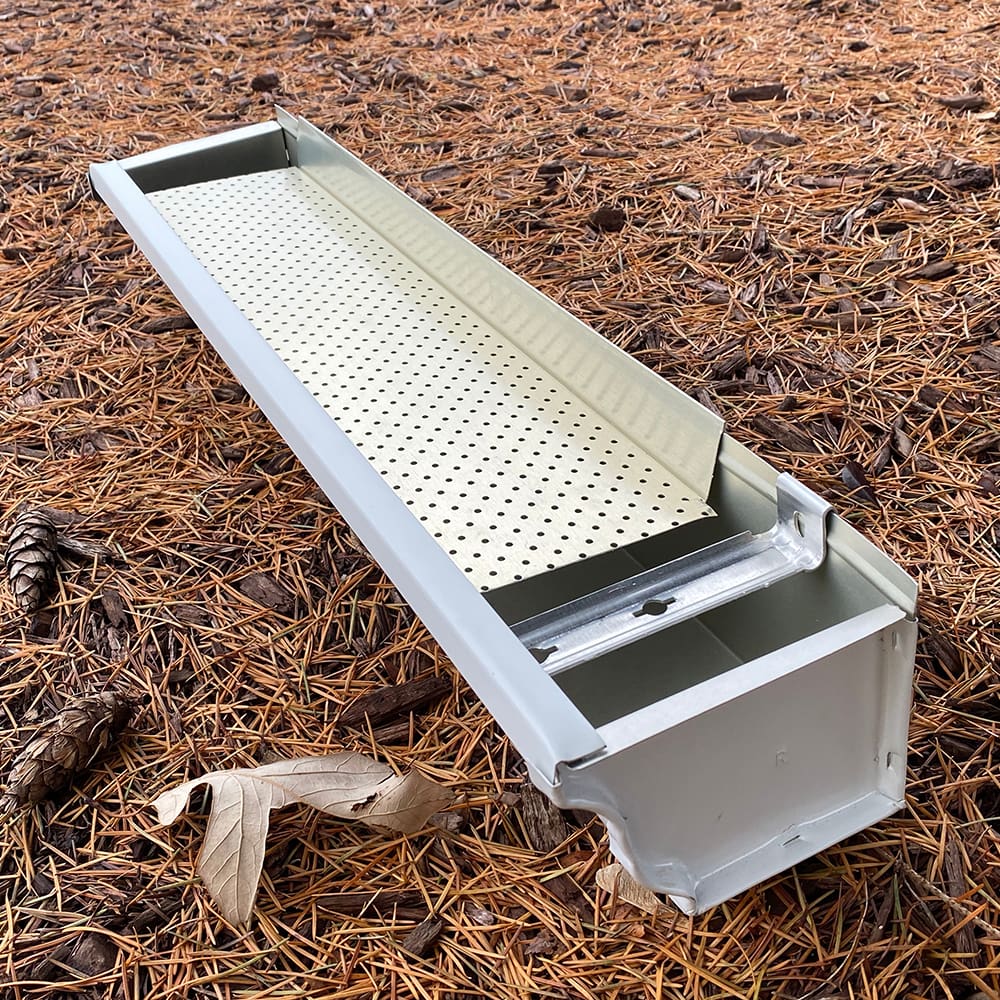

How Do the Main Gutter Guard Types Compare?
Understanding the performance differences between guard types allows you to choose the product that matches your specific tree cover and maintenance goals.
Micro-Mesh Guards: Best All-Around Performance
Micro-mesh guards have a fine stainless steel mesh (opening size: 0.030 to 0.050 inches) bonded to an aluminum support frame. Water flows through the tiny openings while leaves, seeds, pine needles, and most debris cannot pass through and slide off the surface. Independent comparative testing consistently ranks micro-mesh as the most effective residential gutter guard type across the widest range of debris types. The limitation: in high-rainfall events, water can sheet off the guard surface rather than flowing through — proper installation with the correct angle (matching the roof pitch) minimizes this. Cost: $8 to $15 per linear foot installed.
Reverse-Curve Guards: Effective but Maintenance-Dependent
Reverse-curve (surface tension) guards have a solid surface that water follows around the curved edge and into the gutter, while debris falls off the outer edge. They work well with larger debris (oak leaves, maple helicopters) in moderate rainfall. Limitations: in very heavy rain, the water volume can exceed the surface tension effect and water overshoots the gutter opening. Small debris (pine needles, seed pods) can enter the opening with the water. The inside of the gutter and the curved surface must be cleaned periodically despite the guard being a solid cover. Cost: $15 to $45 per linear foot installed, with branded surface-tension systems averaging about $40 per foot. (For more on this, see Do Gutter Guards Work? An Honest Assessment.)
Brush Guards: Lowest Performance, Easy Installation
Brush guards (cylindrical bristle inserts placed inside the gutter) allow water to flow through and around the bristles while catching large debris on the bristle surface. They are DIY-installable and inexpensive. Performance limitations: debris caught in the bristles compacts over time and becomes increasingly difficult to remove. Small debris passes through and accumulates in the gutter beneath the brushes. Cleaning brush guards is more labor-intensive than cleaning uncovered gutters. Most independent testing ranks brush guards last among guard types for performance and maintenance convenience. Consider them for very light debris environments only. (For more on this, see How to Maintain Gutter Guards Over Time.)
Working With a Contractor on This Project
Getting the right outcome on any home services project starts before the work begins. A few consistent practices make the difference between a smooth project and a frustrating one.
Get at least two or three quotes. A single quote gives you no basis for comparison. Two or three quotes reveal the market rate for the work, expose scope differences between bidders, and let you assess contractor communication quality before any commitment is made. The lowest bid is not automatically the best value if the scope is thin or the materials are underspecified.
Ask for licenses and insurance before work starts. Verify current general liability insurance and, for any work involving workers on your property, workers compensation coverage. Licensing requirements vary by state and trade; confirm the specific requirements in your jurisdiction. A licensed contractor who carries appropriate insurance protects both parties if something goes wrong during the project.
Get the scope in writing. A written proposal that specifies materials, labor scope, timeline, what is included (permits, cleanup, disposal), and warranty terms is the foundation of a professional engagement. Verbal agreements on any of these points invite misunderstanding. For any project over $500, written scope is non-negotiable.
Clarify the payment schedule upfront. A reasonable payment schedule ties major payments to project milestones: a deposit at signing, a payment at material delivery or project start, and a final payment at completion after a walkthrough confirms satisfaction. A contractor who requires full payment upfront before work begins is a red flag in any trade.
Making a Confident Decision
The information in this article is designed to help you ask better questions of the professionals you work with, evaluate their answers with more confidence, and understand the decisions involved in this type of home services project. It is not a substitute for professional assessment of your specific home. (For more on this, see Questions to Ask a Gutter Guard Installer.)
Every home is different. Roof slopes, local weather, tree exposure, soil conditions, and existing system condition all affect what the right solution is for your specific situation. The general principles here apply broadly, but a professional who assesses your home in person will give you guidance that accounts for the details that general articles cannot.
When you are ready to move forward, getting at least two or three quotes from licensed, insured, local contractors is the most important practical step. It lets you compare approaches, assess contractor quality, and confirm that the solution proposed matches your specific situation and budget.
Cost figures on this page were checked against published pricing on August 23, 2026. How we source cost data.