
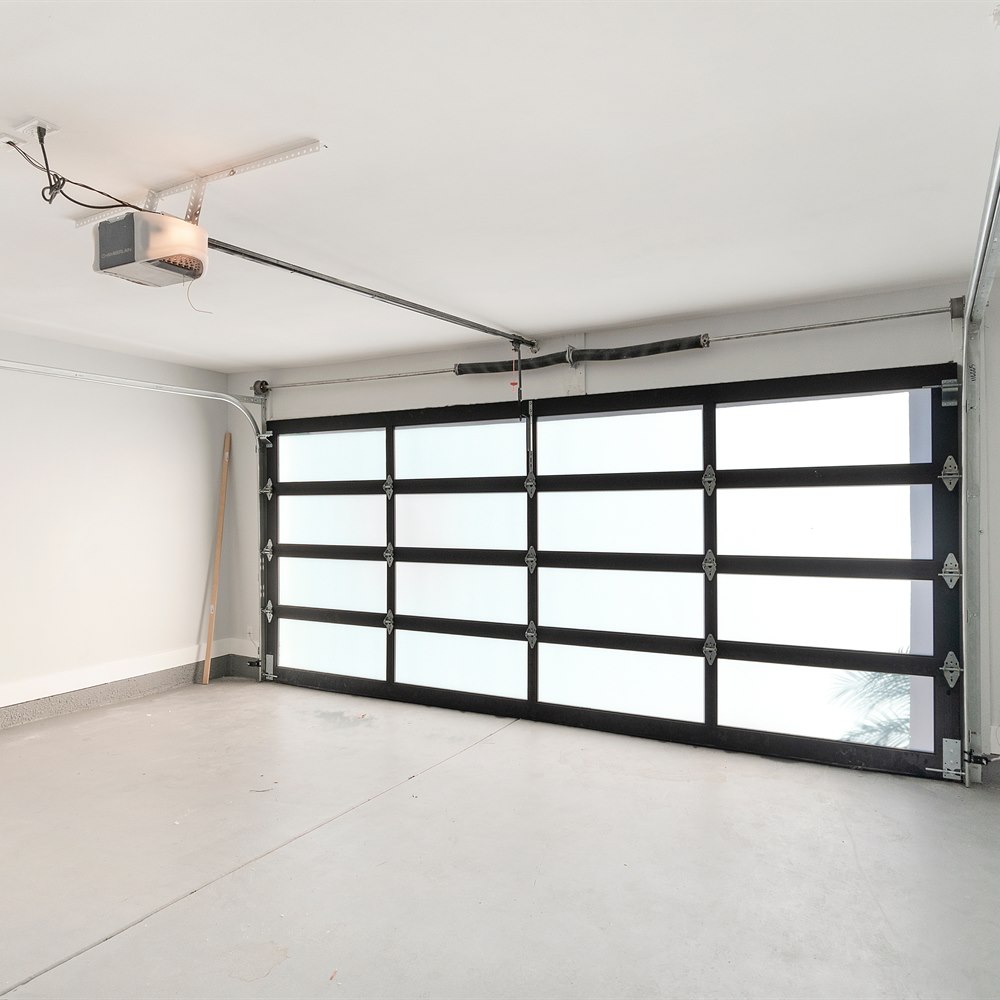
Chain Drive, Belt Drive, or Smart Opener: Which Is Right?
The right garage door opener type depends on the garage’s attachment (attached vs. detached), noise sensitivity, and how much you value smartphone connectivity and battery backup. Here is the comparison.
Chain-Drive: Reliable and Economical
Chain-drive openers at $325 to $550 installed are the most common residential opener type. They are durable, reliable, widely serviced, and the most economical option. Their one meaningful limitation is noise: the metal chain produces a clanking and vibration that is noticeable in adjacent rooms. For detached garages or garages not adjacent to sleeping or working spaces, chain-drive is entirely appropriate. For attached garages where the noise is heard inside the home, belt-drive is the better choice for the modest premium.
Belt-Drive: The Quiet Upgrade
Belt-drive openers at $350 to $600 replace the metal chain with a rubber belt, significantly reducing operational noise. They are the standard recommendation for attached garages, particularly those adjacent to bedrooms or home offices where opener noise is disruptive. Belt drives are otherwise mechanically equivalent to chain drives in reliability and longevity. The modest premium over chain-drive is a clear value for attached applications.
Smart Opener: Connectivity and Convenience
Smart openers at $600 to $1,200 installed add Wi-Fi connectivity, smartphone control from anywhere, activity history, and status notifications. For households where members regularly wonder “did I close the garage?” or want to let delivery drivers into the garage remotely, a smart opener provides immediate value. Most smart openers also include battery backup as standard, which alone justifies a portion of the premium. The premium over a comparable belt-drive is considered a clear value by a significant portion of homeowners who own them. (For more on this, see How Much Does a Garage Door Opener Cost?.)
Making the Decision
Detached garage, budget priority: chain-drive at $325 to $550. Attached garage, noise sensitivity: belt-drive at $350 to $600. Attached garage, want connectivity and battery backup: smart belt-drive at $600 to $1,200. Any garage where the opener is older than 10 to 15 years and lacks auto-reverse or photo-eye sensors: replace regardless of type for safety reasons. (For more on this, see Chain-Drive vs. Belt-Drive vs. Smart Opener: Which Is Best?.)
Garage Door Opener Cost at a Glance
| Cost Factor | Typical Range | Notes |
|---|---|---|
| Basic chain-drive (1/2 HP) | $325 to $550 installed | Most economical and most common. Noisier than belt-drive. Best for detached garages. |
| Belt-drive (1/2 HP) | $350 to $600 installed | Significantly quieter than chain-drive. Standard recommendation for attached garages. |
| Smart opener (Wi-Fi, battery backup) | $600 to $1,200 installed | Includes smartphone control, activity history, and battery backup for power outages. |
| 3/4 HP motor (for heavy doors) | $50 to $150 premium over equivalent 1/2 HP | Required for two-car doors over approximately 160 lbs, wood doors, or high-use applications. |
Cost figures on this page were checked against published pricing on August 23, 2026. How we source cost data.
Installation labor runs $178 to $238 for like-for-like replacement. Additional remotes $25 to $60 each; exterior keypad $30 to $80.
Planning Your Project Budget
The cost ranges in this article are based on industry data and are intended as planning benchmarks, not fixed prices. The actual cost for your project depends on your specific home, your local labor market, the current price of materials, and the scope the contractor confirms after a site inspection.
Always get at least two written quotes on equivalent defined scope before committing to any home services project. Wide price variation between quotes usually reflects differences in material quality, scope completeness (what is included and what is not), or contractor overhead and experience level rather than simple price competition.
Use the cost data in this article to ask better questions during the quoting process: What material is included? What does that per-square-foot or per-linear-foot rate include and exclude? Are permits, cleanup, and disposal included? What is the warranty on labor? These questions turn a quote into a comparable basis for decision-making. (For more on this, see Questions to Ask Before Buying a Garage Door Opener.)
Working With a Contractor on This Project
Getting the right outcome on any home services project starts before the work begins. A few consistent practices make the difference between a smooth project and a frustrating one.
Get at least two or three quotes. A single quote gives you no basis for comparison. Two or three quotes reveal the market rate for the work, expose scope differences between bidders, and let you assess contractor communication quality before any commitment is made. The lowest bid is not automatically the best value if the scope is thin or the materials are underspecified.
Ask for licenses and insurance before work starts. Verify current general liability insurance and, for any work involving workers on your property, workers compensation coverage. Licensing requirements vary by state and trade; confirm the specific requirements in your jurisdiction. A licensed contractor who carries appropriate insurance protects both parties if something goes wrong during the project.
Get the scope in writing. A written proposal that specifies materials, labor scope, timeline, what is included (permits, cleanup, disposal), and warranty terms is the foundation of a professional engagement. Verbal agreements on any of these points invite misunderstanding. For any project over $500, written scope is non-negotiable.
Clarify the payment schedule upfront. A reasonable payment schedule ties major payments to project milestones: a deposit at signing, a payment at material delivery or project start, and a final payment at completion after a walkthrough confirms satisfaction. A contractor who requires full payment upfront before work begins is a red flag in any trade.