
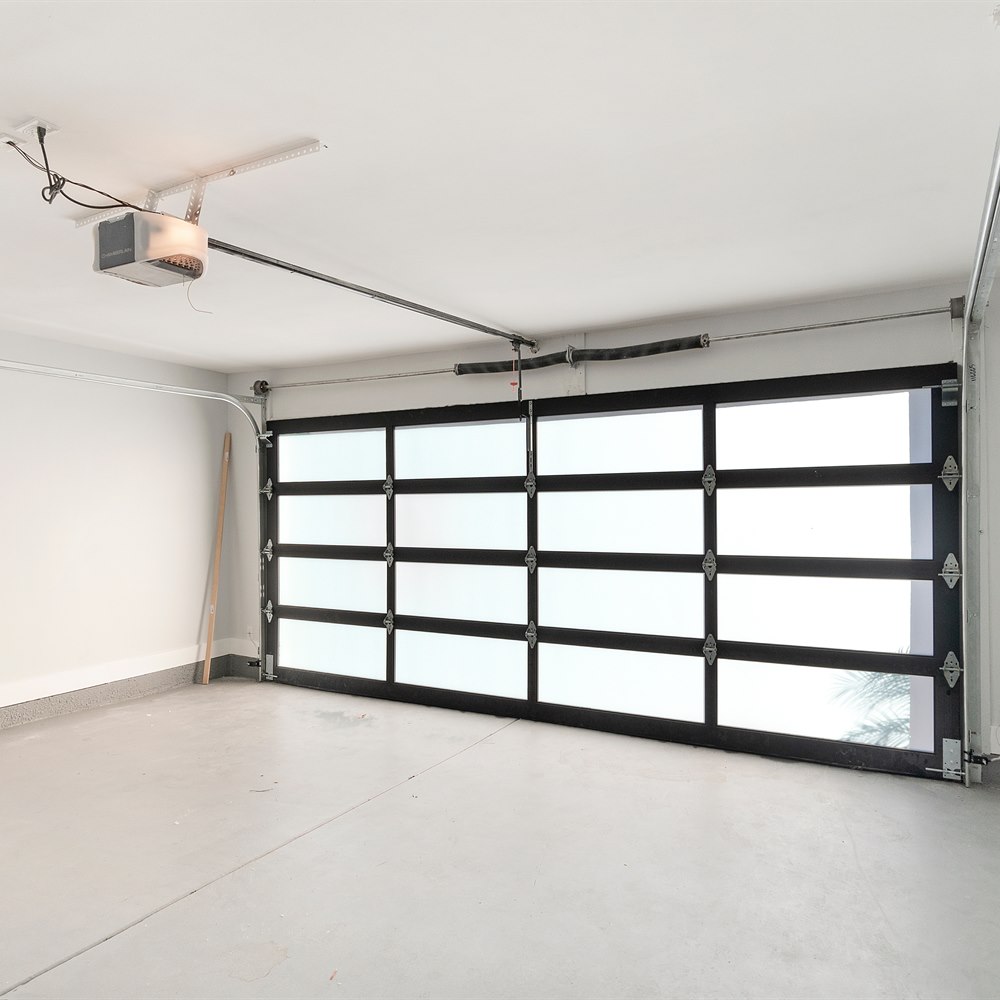
What Is the Quietest Garage Door Opener?
A direct-drive jackshaft opener is the quietest, and the Chamberlain RJO101 runs $579 at Home Depot for the opener alone, before installation labor. It mounts on the wall beside the door, so no drive mechanism hangs above the living space. LiftMaster’s dealer-installed equivalent is the 98022, which replaced the discontinued 8500W. Among ceiling-mount openers, belt drive is significantly quieter than chain: the LiftMaster 87504-267 (about $580 for the opener alone, before installation labor) and the Chamberlain B4603T ($307.77 at Home Depot) are the current belt-drive, DC-motor models from the two brands. Swapping metal rollers for nylon precision-sealed rollers cuts door noise another 30 to 50 percent, which matters most when bedrooms sit next to or above the garage.
Belt-Drive: The Quietest Standard Ceiling-Mount Option
A belt-drive opener (rubber belt rather than metal chain) produces significantly less noise and vibration than a chain-drive at the same horsepower and speed rating. The noise reduction is primarily in the drive mechanism — but the door itself produces noise as it moves through the track, which is controlled by roller quality (see below). Recommended belt-drive openers: the LiftMaster 87504-267 (belt drive, DC motor, Wi-Fi, battery backup: about $580 for the opener alone, before $178 to $238 of installation labor) and the Chamberlain B4603T (belt drive, DC motor, Wi-Fi, 1,000-lumen LED: $307.77 at Home Depot). Both makers describe these units as ultra-quiet; the Chamberlain B6765T this guide previously named is no longer listed among Chamberlain’s belt-drive openers at Home Depot. The LiftMaster and Chamberlain brands share the same underlying platform and engineering, as both are made by The Chamberlain Group. (For more on this, see Chain-Drive vs. Belt-Drive vs. Smart Opener: Which Is Best?.)
Direct-Drive (Jackshaft): The Quietest Overall
A jackshaft opener (which mounts on the wall beside the door and drives the torsion bar directly, with no overhead rail trolley) produces less vibration than any ceiling-mounted opener because the drive mechanism is not suspended above the living space. The LiftMaster 8500W has been discontinued. LiftMaster’s current wall-mount is the 98022, which the company describes as nearly silent and vibration-free and backs with a lifetime motor warranty and 5 years on parts; LiftMaster sells through installing dealers and publishes no list price, so that one arrives as an installed quote. The retail-priced equivalent from the same manufacturer is the Chamberlain RJO101 at $579 at Home Depot, before installation labor — Chamberlain calls it the quietest opener in its line, and it has the same wall-mount layout, battery backup and myQ Wi-Fi. The jackshaft opener is the best choice for: attached garages with living space directly above (a bedroom or office), garages with limited ceiling clearance (which prevents ceiling-mount installation), and homeowners who want the maximum noise reduction available. (For more on this, see Garage Door Opener Buying Guide: What to Know Before You Buy.)
Roller Upgrade: The Overlooked Noise Reduction
The door rollers (small wheels that run in the vertical and curved tracks) produce significant noise when they are metal or worn nylon. Replacing standard rollers with precision-sealed nylon rollers (about $1.60 to $4.40 per roller, 10 to 12 rollers on a standard door: roughly $20 to $55 in parts, $100 to $200 installed): reduces door operation noise by 30 to 50 percent independently of the opener. If quiet operation is the goal: replace both the opener (to belt or direct drive) and the rollers (to nylon precision sealed) simultaneously for the maximum noise reduction. (For more on this, see Chain vs. Belt vs. Smart Garage Door Opener: Which Is Right?.)
Working With a Contractor on This Project
Getting the right outcome on any home services project starts before the work begins. A few consistent practices make the difference between a smooth project and a frustrating one.
Get at least two or three quotes. A single quote gives you no basis for comparison. Two or three quotes reveal the market rate for the work, expose scope differences between bidders, and let you assess contractor communication quality before any commitment is made. The lowest bid is not automatically the best value if the scope is thin or the materials are underspecified.
Ask for licenses and insurance before work starts. Verify current general liability insurance and, for any work involving workers on your property, workers compensation coverage. Licensing requirements vary by state and trade; confirm the specific requirements in your jurisdiction. A licensed contractor who carries appropriate insurance protects both parties if something goes wrong during the project.
Get the scope in writing. A written proposal that specifies materials, labor scope, timeline, what is included (permits, cleanup, disposal), and warranty terms is the foundation of a professional engagement. Verbal agreements on any of these points invite misunderstanding. For any project over $500, written scope is non-negotiable.
Clarify the payment schedule upfront. A reasonable payment schedule ties major payments to project milestones: a deposit at signing, a payment at material delivery or project start, and a final payment at completion after a walkthrough confirms satisfaction. A contractor who requires full payment upfront before work begins is a red flag in any trade.
How to Use This Guide
Finding the right contractor is the most important decision in any home services project. The criteria in this article reflect what distinguishes contractors who deliver excellent work from those who do not, based on the specific quality factors that matter for this type of work.
Use the criteria here as a screening framework, not a checklist to be completed mechanically. A contractor who scores well on the criteria that matter most for your specific project, home, and concerns is a better match than one who technically checks every box but does not communicate clearly or does not have local experience with your type of home.
The right contractor is one who provides a clear, written proposal with specific materials and scope, is licensed and insured, has verifiable local references from similar work, and backs their installation with a meaningful warranty. When you are ready to compare your options, use the button below to connect with qualified local professionals in your area.
Cost figures on this page were checked against published pricing on September 2, 2026. How we source cost data.