
What Drives AC Repair Costs?
AC repair costs from $150 to $5,000 are primarily determined by what component failed, how old the system is, and when the call is made. Here is the breakdown.
Type of Repair Needed
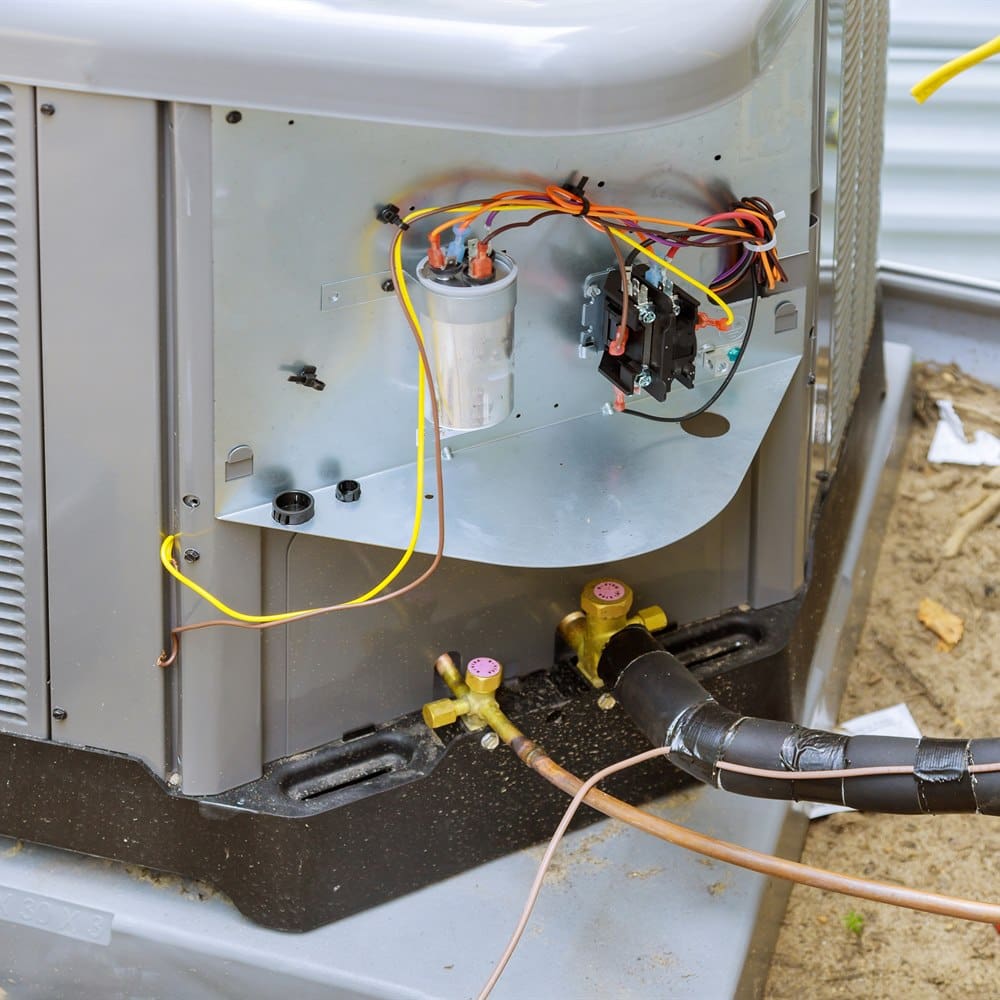
The failed component is the dominant cost driver. Minor electrical components (capacitors, contactors, fuses) are inexpensive parts with straightforward replacement $100 to $600 total. Motors (condenser fan, evaporator fan, blower) are mid-range $500 to $1,500. Refrigerant issues require both leak repair and refrigerant addition $350 to $1,000 to find the leak, repair it, and recharge, depending on leak location and severity. A top-off with no leak search is a different job at $405 to $900. The compressor is the most expensive component $1,600 to $4,800 installed. Evaporator and condenser coils sit in the same tier, an evaporator coil at $2,100 to $4,800 and a condenser coil at $300 to $4,200.
Refrigerant Type
Older AC systems (installed before 2010) use R-22 refrigerant (Freon), which has been phased out under EPA regulations and is now significantly more expensive due to limited supply. An R-22 system costs about twice as much to charge as a modern one: R-22 runs $90 to $150 per pound installed against $40 to $90 per pound for R-410A. Systems still operating on R-22 that develop refrigerant leaks are often more economically replaced than recharged repeatedly. ENERGY STAR publishes certified efficiency ratings for heating and cooling equipment, which is the cleanest way to compare models.
System Age and Parts Availability
Older systems (15+ years) may have parts that are discontinued or available only from specialty suppliers at premium prices. An OEM compressor for a 20-year-old system may cost significantly more than a standard compressor for a current model. Newer systems under warranty have parts covered or available at manufacturer pricing. The age of the system affects both parts cost and the wisdom of the repair investment. (For more on this, see AC Repair Cost: What to Expect This Year.)
Emergency vs. Scheduled Service
AC failures on the hottest days of summer are peak demand for HVAC services companies charge emergency or overtime rates for same-day or after-hours calls. Emergency, evening, and weekend calls carry a posted premium, commonly a flat $199 to $250 added to the repair, and some companies mark the job up 50 to 100 percent instead. Annual maintenance contracts often include priority scheduling and discounted repair rates for existing customers.
AC Repair Cost at a Glance
| Cost Factor | Typical Range | Notes |
|---|---|---|
| Diagnostic or service call | $75 to $200, often credited toward repair | Billed separately from the repair itself |
| Common repairs (capacitor, contactor, fan or blower motor) | $150 to $1,500 | A capacitor is $100 to $500 and a contactor $200 to $600, but a condenser fan motor runs $500 to $900 and an ECM blower motor $1,000 to $1,500 |
| Refrigerant | $350 to $1,000 to find the leak, repair it, and recharge | A top-off with no leak search is a different job at $405 to $900, and R-22 costs about twice as much per pound as R-410A |
| Major component (compressor, evaporator or condenser coil) | $1,600 to $5,000 | At this level weigh the repair against a $6,000 to $15,000 replacement |
| Overall range | $150 to $5,000, averaging $600 |
Cost figures on this page were checked against published pricing on August 25, 2026. How we source cost data.
Planning Your Project Budget
The cost ranges in this article are based on industry data and are intended as planning benchmarks, not fixed prices. The actual cost for your project depends on your specific home, your local labor market, the current price of materials, and the scope the contractor confirms after a site inspection.
Always get at least two written quotes on equivalent defined scope before committing to any home services project. Wide price variation between quotes usually reflects differences in material quality, scope completeness (what is included and what is not), or contractor overhead and experience level rather than simple price competition.
Use the cost data in this article to ask better questions during the quoting process: What material is included? What does that per-square-foot or per-linear-foot rate include and exclude? Are permits, cleanup, and disposal included? What is the warranty on labor? These questions turn a quote into a comparable basis for decision-making.
Working With a Contractor on This Project
Getting the right outcome on any home services project starts before the work begins. A few consistent practices make the difference between a smooth project and a frustrating one.
Get at least two or three quotes. A single quote gives you no basis for comparison. Two or three quotes reveal the market rate for the work, expose scope differences between bidders, and let you assess contractor communication quality before any commitment is made. The lowest bid is not automatically the best value if the scope is thin or the materials are underspecified.
Ask for licenses and insurance before work starts. Verify current general liability insurance and, for any work involving workers on your property, workers compensation coverage. Licensing requirements vary by state and trade; confirm the specific requirements in your jurisdiction. A licensed contractor who carries appropriate insurance protects both parties if something goes wrong during the project.
Get the scope in writing. A written proposal that specifies materials, labor scope, timeline, what is included (permits, cleanup, disposal), and warranty terms is the foundation of a professional engagement. Verbal agreements on any of these points invite misunderstanding. For any project over $500, written scope is non-negotiable.
Clarify the payment schedule upfront. A reasonable payment schedule ties major payments to project milestones: a deposit at signing, a payment at material delivery or project start, and a final payment at completion after a walkthrough confirms satisfaction. A contractor who requires full payment upfront before work begins is a red flag in any trade.


