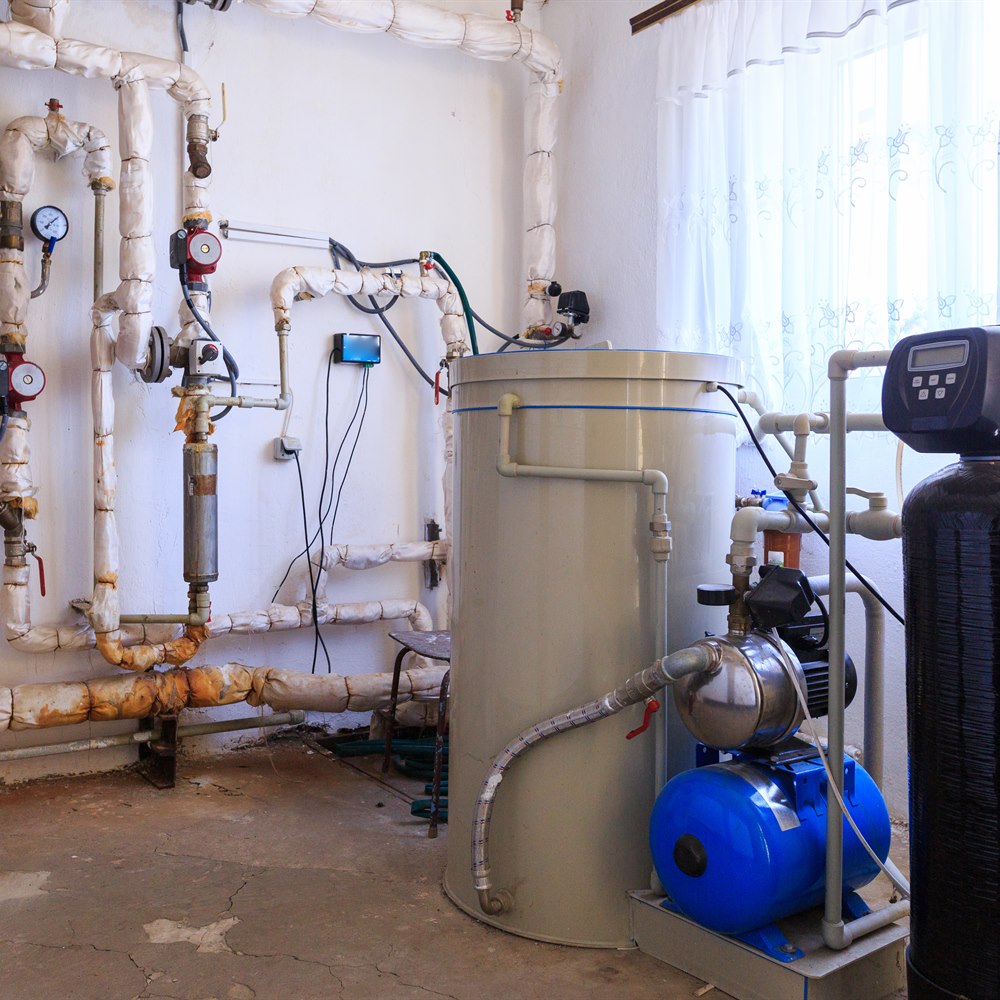
How Do You Maintain a Water Softener?
A water softener requires regular maintenance to continue performing as designed. Here is the complete maintenance schedule.
Salt Replenishment: Monthly
The softener’s brine tank must be kept filled with softening salt or potassium chloride for the ion exchange process to work. Check the brine tank monthly — the salt level should be at least one-third full. Most households use 40 to 50-pound bags of softening salt ($7 to $15 each) every 4 to 6 weeks depending on water hardness and usage. Use pellet salt (not rock salt or solar salt) for most softeners — pellets dissolve cleanly and produce less sludge in the brine tank. High-iron water requires iron-out salt or a dedicated iron pre-filter to prevent resin fouling. (For more on this, see Common Water Softener Problems and How to Fix Them.)
Brine Tank Cleaning: Every 1 to 2 Years
Even with regular salt replenishment, the brine tank gradually accumulates a sludge of salt residue and debris at the bottom. Brine tank cleaning removes this accumulation: disconnect the softener from service, scoop out remaining salt, rinse the tank thoroughly, and reconnect. This 30 to 60-minute process prevents the sludge from clogging the brine pickup tube and degrading regeneration efficiency. Signs the brine tank needs cleaning: a crust forming above the water level in the tank (salt bridge) or a reduction in soft water quality despite adequate salt levels. (For more on this, see Salt-Based vs. Salt-Free Water Systems: Which Is Right?.)
Resin Bed Inspection: Every 3 to 5 Years
The ion exchange resin beads inside the softener tank degrade over time, losing their exchange capacity. Resin inspection (and replacement when needed) is a plumber service at $150 to $300 to inspect and clean the resin bed, or $300 to $600 to replace the resin if it has lost significant capacity. Signs of resin depletion: hard water returning despite the softener running correctly, with salt replenishment current. Resin life: 10 to 15 years in most installations. (For more on this, see How Much Does It Cost to Install a Water Softener?.)
Working With a Contractor on This Project
Getting the right outcome on any home services project starts before the work begins. A few consistent practices make the difference between a smooth project and a frustrating one.
Get at least two or three quotes. A single quote gives you no basis for comparison. Two or three quotes reveal the market rate for the work, expose scope differences between bidders, and let you assess contractor communication quality before any commitment is made. The lowest bid is not automatically the best value if the scope is thin or the materials are underspecified.
Ask for licenses and insurance before work starts. Verify current general liability insurance and, for any work involving workers on your property, workers compensation coverage. Licensing requirements vary by state and trade; confirm the specific requirements in your jurisdiction. A licensed contractor who carries appropriate insurance protects both parties if something goes wrong during the project.
Get the scope in writing. A written proposal that specifies materials, labor scope, timeline, what is included (permits, cleanup, disposal), and warranty terms is the foundation of a professional engagement. Verbal agreements on any of these points invite misunderstanding. For any project over $500, written scope is non-negotiable.
Clarify the payment schedule upfront. A reasonable payment schedule ties major payments to project milestones: a deposit at signing, a payment at material delivery or project start, and a final payment at completion after a walkthrough confirms satisfaction. A contractor who requires full payment upfront before work begins is a red flag in any trade.
Making a Confident Decision
The information in this article is designed to help you ask better questions of the professionals you work with, evaluate their answers with more confidence, and understand the decisions involved in this type of home services project. It is not a substitute for professional assessment of your specific home.
Every home is different. Roof slopes, local weather, tree exposure, soil conditions, and existing system condition all affect what the right solution is for your specific situation. The general principles here apply broadly, but a professional who assesses your home in person will give you guidance that accounts for the details that general articles cannot.
When you are ready to move forward, getting at least two or three quotes from licensed, insured, local contractors is the most important practical step. It lets you compare approaches, assess contractor quality, and confirm that the solution proposed matches your specific situation and budget.
Water Treatment Cost at a Glance
The right treatment depends on your specific water quality problem — test before you buy.
| Cost Factor | Typical Range | Notes |
|---|---|---|
| Water softener unit | $400 to $2,500 | — varies by type and capacity, from basic ion-exchange to dual-tank |
| Professional installation | $300 to $700 | — higher if additional plumbing work is needed |
| Annual maintenance | $100 to $400 per year | — salt runs $50 to $150 a year, and professional servicing adds $150 to $300 when you use it |
| Overall range | $700 to $3,400 | , averaging $1,700 for softener purchase and installation combined |
Cost figures on this page were checked against published pricing on August 29, 2026. How we source cost data.