What Is a Reverse Osmosis System and Is It Worth It?
An under-sink reverse osmosis system costs $300 to $1,600 installed and removes 95 to 99 percent of dissolved contaminants, including lead, arsenic, nitrates, fluoride, and chloramine. That makes RO the most comprehensive point-of-use water treatment available for a home, and it is worth the money when you have a specific contaminant to remove or want reliably clean drinking water. Filters add $60 to $180 a year, and the membrane $50 to $150 every 2 to 3 years.
How Reverse Osmosis Works
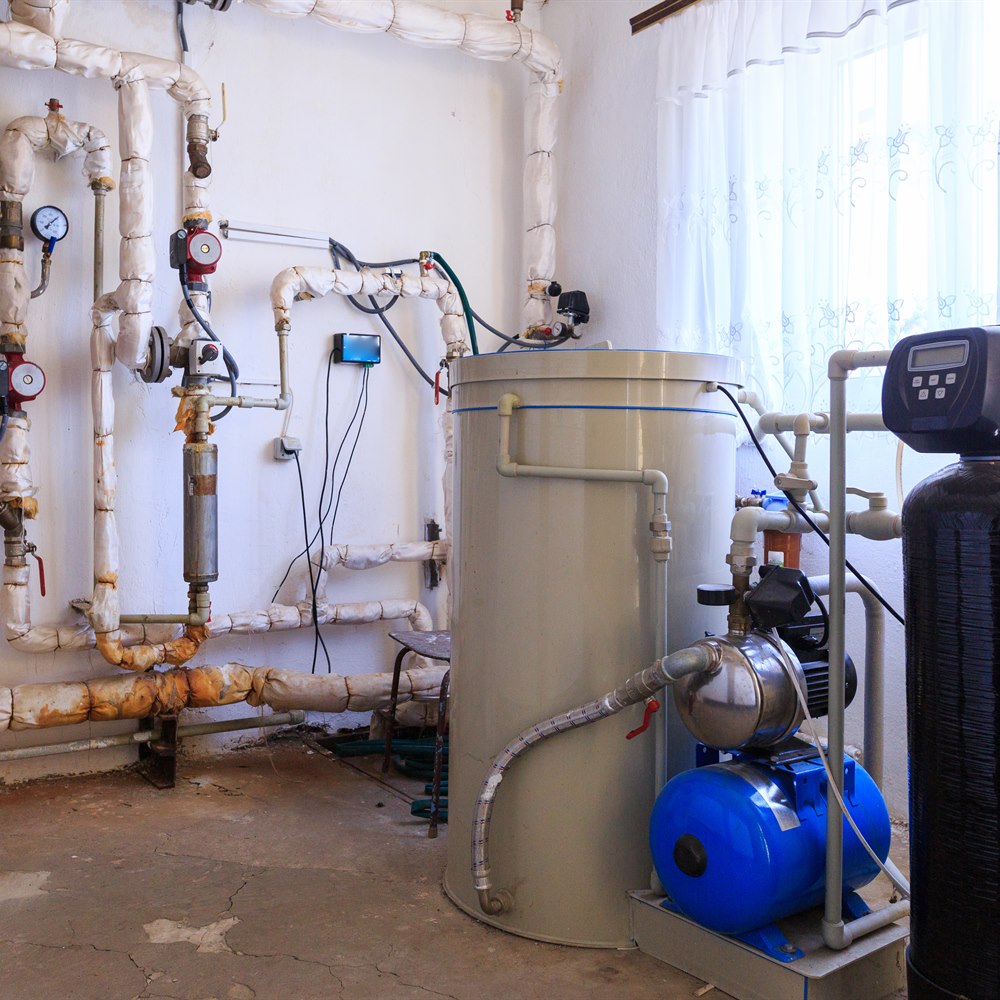
Reverse osmosis forces water through a semi-permeable membrane under pressure, removing dissolved solids, heavy metals, minerals, bacteria, viruses, and most organic contaminants. A typical under-sink RO system has 3 to 5 stages: a sediment pre-filter (removes particles), a carbon pre-filter (removes chlorine that would damage the membrane), the RO membrane (the primary treatment stage), a post-carbon filter (removes any residual taste), and a storage tank (holds 2 to 4 gallons of treated water). Most RO systems remove 95 to 99 percent of dissolved contaminants, including lead, arsenic, nitrates, fluoride, and chloramine. (For more on this, see What Affects Water Treatment Cost?.)
Cost
Under-sink 4 to 5-stage RO system: $200 to $1,000 for the unit. Professional installation: $100 to $600 (adding a dedicated faucet and drain connection, and more where a new water line has to be drilled). Total installed: $300 to $1,600. Annual filter maintenance: $60 to $180 for pre-filters and post-filters replaced annually. RO membrane: $50 to $150 every 2 to 3 years. Countertop RO units: $100 to $700 without installation, plug-and-play. Whole-home RO: $3,000 to $8,000 installed — not recommended for most situations.
When RO Is Worth the Investment
For any household concerned about lead (particularly in older homes with lead solder or lead service lines), nitrates (rural homes near agriculture with private wells), arsenic (specific geographic regions with naturally occurring arsenic in groundwater), or comprehensive general water quality improvement for drinking water: an under-sink RO system at $300 to $1,600 is one of the highest-value home investments available. The ongoing cost ($60 to $180 a year in filters) is a fraction of bottled water spending for equivalent water quality. (For more on this, see The Best Water Treatment System for Your Situation.)
Working With a Contractor on This Project
Getting the right outcome on any home services project starts before the work begins. A few consistent practices make the difference between a smooth project and a frustrating one.
Get at least two or three quotes. A single quote gives you no basis for comparison. Two or three quotes reveal the market rate for the work, expose scope differences between bidders, and let you assess contractor communication quality before any commitment is made. The lowest bid is not automatically the best value if the scope is thin or the materials are underspecified.
Ask for licenses and insurance before work starts. Verify current general liability insurance and, for any work involving workers on your property, workers compensation coverage. Licensing requirements vary by state and trade; confirm the specific requirements in your jurisdiction. A licensed contractor who carries appropriate insurance protects both parties if something goes wrong during the project. (For more on this, see Questions to Ask Before Getting a Water Treatment System.)
Get the scope in writing. A written proposal that specifies materials, labor scope, timeline, what is included (permits, cleanup, disposal), and warranty terms is the foundation of a professional engagement. Verbal agreements on any of these points invite misunderstanding. For any project over $500, written scope is non-negotiable.
Clarify the payment schedule upfront. A reasonable payment schedule ties major payments to project milestones: a deposit at signing, a payment at material delivery or project start, and a final payment at completion after a walkthrough confirms satisfaction. A contractor who requires full payment upfront before work begins is a red flag in any trade.
Making a Confident Decision
The information in this article is designed to help you ask better questions of the professionals you work with, evaluate their answers with more confidence, and understand the decisions involved in this type of home services project. It is not a substitute for professional assessment of your specific home.
Every home is different. Roof slopes, local weather, tree exposure, soil conditions, and existing system condition all affect what the right solution is for your specific situation. The general principles here apply broadly, but a professional who assesses your home in person will give you guidance that accounts for the details that general articles cannot.
When you are ready to move forward, getting at least two or three quotes from licensed, insured, local contractors is the most important practical step. It lets you compare approaches, assess contractor quality, and confirm that the solution proposed matches your specific situation and budget.
Water Treatment Cost at a Glance
The right treatment depends on your specific water quality problem — test before you buy.
Water softener unit: $400 to $2,500 — varies by type and capacity, from basic ion-exchange to dual-tank.
| Cost Factor | Typical Range | Notes |
|---|---|---|
| Professional installation | $300 to $700 | — higher if additional plumbing work is needed |
| Annual maintenance | $100 to $400 per year | — salt runs $50 to $150 a year, and professional servicing adds $150 to $300 when you use it |
| Overall range | $700 to $3,400 | , averaging $1,700 for softener purchase and installation combined |
Cost figures on this page were checked against published pricing on August 29, 2026. How we source cost data.