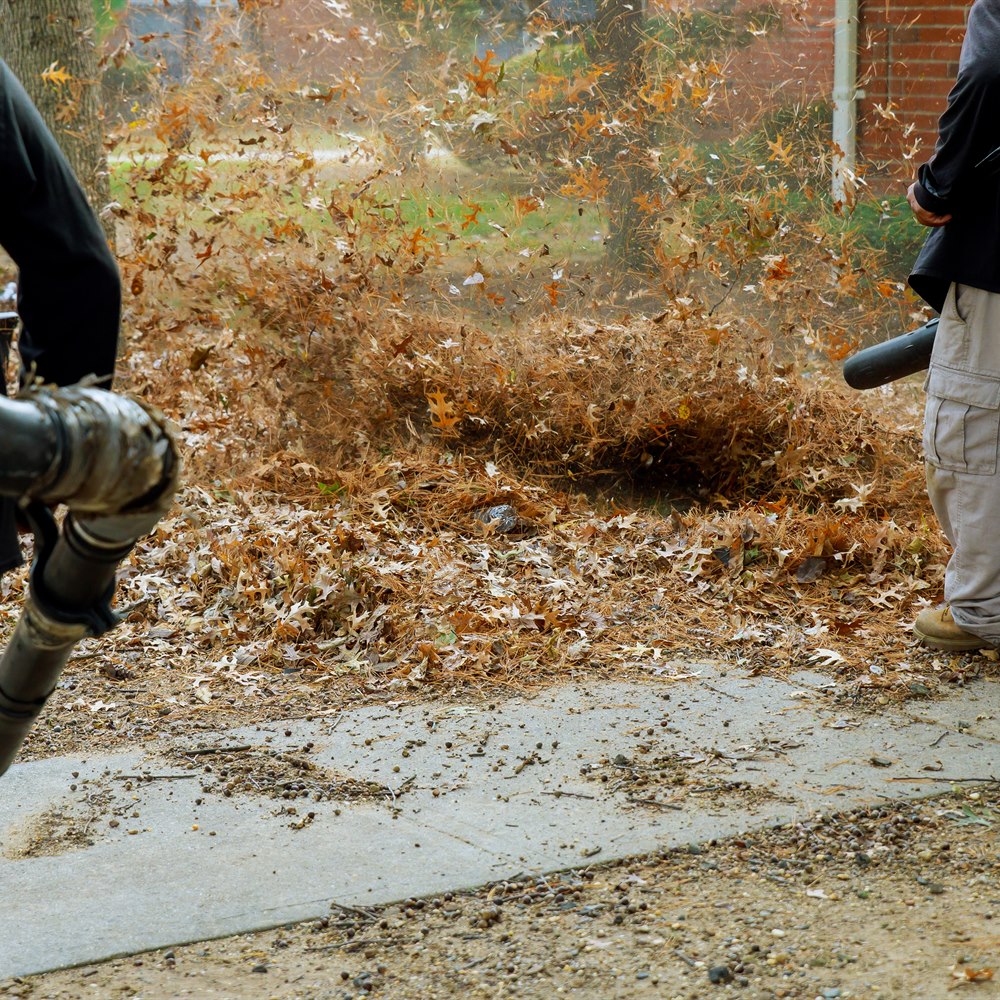

What Does Leaf Removal Cost?
Professional leaf removal costs $150 to $800, averaging around $275. Property size, leaf volume, and scope drive the number, along with whether the debris is hauled away or left at the curb.
Small Yard, Light Cover: $150 to $250
A small residential yard under a quarter acre with light to moderate leaf cover runs $150 to $250 for a professional visit. Light cover means one pass with a blower plus a vacuum or tarp-and-haul is enough. The price covers blowing or raking leaves off turf and beds, consolidating them, and either bagging them or blowing them to the curb for municipal pickup. This is the typical range for standard suburban lots where leaves are a seasonal nuisance rather than an overwhelming accumulation.
Large or Wooded Property: $300 to $800
A half-acre to one-acre lot, or any property with several mature deciduous trees, runs $300 to $800. Heavy leaf volume takes substantially more time to blow, rake, consolidate, and remove, and thick layers require multiple passes and significant hauling. Extensive planting beds, nooks, and complex or sloped terrain slow the work further and push a property toward the top of the range. Volume and time, not lot size alone, drive the cost on tree-dense properties.
Full Fall Cleanup: $200 to $600
Fall cleanup goes well beyond leaves: cutting back perennials and ornamental grasses, removing annuals, cleaning debris from planting beds, edging bed borders, pruning dead wood, and often gutter cleaning. On a medium-size property it runs $200 to $600 and typically takes 4 to 8 hours of crew time. It puts the property to bed for winter rather than simply clearing leaves off the turf, and the added cost depends on bed complexity and condition.
Leaf Removal Cost at a Glance
| Service | Cost |
|---|---|
| Small yard, light to moderate cover | $150 to $250 |
| Large or wooded property | $300 to $800 |
| Full fall cleanup, medium property | $200 to $600 |
| Hauling debris away, add-on | $50 to $150 |
| Mulching leaves in place with your own mower | Free |
| Overall range | $150 to $800, averaging $275 |
Cost figures on this page were checked against published pricing on September 2, 2026. How we source cost data.
Hauling or Curbside Drop
Blowing leaves to the curb for municipal pickup is the lowest-cost disposal option, and most cities and townships in the Midwest, Mid-Atlantic, and Northeast run curbside leaf collection in October and November. Having the crew haul the leaves away by truck adds $50 to $150 for an average property. Check whether municipal pickup is available on your street and when the collection window runs before paying the hauling premium — if the timing lines up with your cleanup, it is money saved for nothing given up.
How Many Visits You Need
Most properties need one to three cleanups per fall, depending on tree count and drop timing. Mature maples, oaks, and sweetgums drop over a 4 to 6-week stretch across October and November. One comprehensive visit after peak drop handles many properties. A yard with both early-dropping and late-dropping trees does better with two visits, one in October and one in November after the late trees finish. Properties bordered by woods that keep depositing leaves all season often need 2 to 3 separate visits, which raises the seasonal total well above any single-visit price.
Mulching Leaves Instead of Removing Them
You do not have to remove every leaf. A mulching mower, or a mulching blade on a standard mower, chops leaves into fine pieces that break down quickly and return nutrients to the soil. Light to moderate cover mulches in effectively with 2 to 3 mowing passes. Heavy cover more than 6 inches deep should be partially removed first, or the mulched layer will smother the turf. Mulching is free and good for the lawn, which makes it the best value option on properties where the volume is manageable.
Comparing Pricing Models and Quotes
Providers price leaf removal two ways: per visit, invoiced separately each time, or as a seasonal agreement covering all fall service. Per-visit pricing suits homeowners who want one or two cleanups and handle the rest themselves, though one-time service tends to sit toward the higher end of the range because providers price in the uncertainty of one-off scheduling. Seasonal agreements often produce a lower effective per-visit rate, since route efficiency and predictable scheduling benefit the provider, who passes some of that back. Recurring service on a weekly or biweekly schedule during peak fall is generally cheaper per visit than one-time work. (For more on this, see What Affects the Cost of Leaf Removal?.)
The difference matters for budgeting. A seasonal total is known upfront, while per-visit billing accumulates unpredictably if the fall is long or unusually leafy. On a property with heavy tree coverage where three or four visits are likely, the seasonal number is the one to plan around. On a modest lot where one or two cleanups will do, per-visit avoids committing to service you will not use. Ask any provider both how they structure pricing and what a full season would total under either model.
A solid leaf removal quote states four things: the service area, meaning turf only or turf plus beds; the disposal method, curbside or hauled away; the number of visits or the seasonal scope; and whether gutters are included or billed separately. A quote that specifies all four lets you compare providers on equivalent scope instead of guessing at what each one includes. (For more on this, see Questions to Ask a Leaf Removal Service.)
Tell the provider what you need rather than asking what they offer — it produces clearer responses and more comparable numbers. Get at least two written quotes on that same defined scope, and treat the ranges here as planning benchmarks rather than fixed prices, since access difficulty and local labor rates both move the final figure. If you already use a mowing company, confirm before fall whether leaf removal visits are included in your contract or priced separately. (For more on this, see Leaf Removal Services: How to Find a Reliable Company.)
Frequently Asked Questions
Leaf removal runs $150 to $800, averaging $275. A small yard with light to moderate cover is $150 to $250, a large or wooded property with heavy volume is $300 to $800, and a full fall cleanup including beds and gutters runs $200 to $600 on a medium-size property.
One to three, depending on tree count and drop timing. Mature maples, oaks, and sweetgums drop over 4 to 6 weeks in October and November, so one comprehensive visit after peak drop works for many properties. Yards with both early and late-dropping trees do better with two visits, and wooded lots often need 2 to 3.
Yes, $50 to $150 for an average property. Blowing leaves to the curb for municipal pickup is the cheaper option, and most cities and townships in the Midwest, Mid-Atlantic, and Northeast run curbside collection in October and November. Confirm your local pickup schedule before paying the hauling premium.
Yes. A mulching mower or a mulching blade chops leaves into fine pieces that decompose and return nutrients to the soil, and light to moderate cover mulches in with 2 to 3 passes. Cover deeper than 6 inches should be partially removed first to avoid smothering the turf. Mulching is free and good for the lawn.
Leaf removal addresses only leaf debris from turf and surface areas. Fall cleanup adds cutting back perennials and ornamental grasses, bed cleanup, edging, pruning cleanup, and often gutter cleaning, running $200 to $600 and 4 to 8 hours of crew time on a medium property. It prepares the whole property for winter rather than just clearing leaves.
Yes, $300 to $800 versus $150 to $250 for a small open lot. Heavy accumulation takes more time to blow, rake, consolidate, and remove, thick layers need multiple passes, and extensive beds, complex terrain, or difficult access compound the work. Volume and time, not lot size alone, set the price.
Per visit, usually yes. One-time service is priced toward the higher end because providers absorb the uncertainty of one-off scheduling, while recurring weekly or biweekly service during peak fall benefits from route efficiency and predictable labor. Seasonal agreements often produce a lower effective per-visit rate and a known total upfront.
Occasional leaf blowing from hard surfaces may be included in mowing visits, but comprehensive removal from turf and beds is typically a separate, separately priced service, billed per visit or bundled into a fall cleanup package. Confirm with your mowing company before the fall season which applies to your contract.