What Hidden Costs Come With Playground Equipment?
The playset purchase price is the starting point, and professional assembly adds $700 to $900 for most mid-range structures, more for large or complex ones. Site preparation and leveling, safety surfacing across a zone that extends past the equipment footprint, and ongoing maintenance are the other costs that catch homeowners off guard. Here’s what to plan for.
Site Preparation and Ground Leveling
Playground equipment requires a reasonably level installation surface. If the intended location slopes or is uneven, site preparation, grading or leveling, adds cost before the equipment goes up. This can range from a minor adjustment to significant earthwork depending on the terrain. Additionally, clearing the area of roots, debris, or existing landscaping that conflicts with the footprint is real labor that isn’t in the equipment price. (For more on this, see How Long Does Playground Equipment Installation Take?.)
Safety Surfacing
Safety surfacing under and around playground equipment is strongly recommended and, in some municipal installations, required. The two common options are wood mulch or engineered wood fiber (affordable, natural appearance, requires maintenance and replenishment) and rubber mulch or pour-in-place rubber surfaces (more expensive upfront, lower maintenance, longer-lasting). A properly sized safety zone extending beyond the equipment footprint can require a substantial volume of material, often more than homeowners anticipate. This is one of the most underestimated costs of a backyard playground. (For more on this, see How Much Does Playground Equipment Cost?.) The CPSC’s Public Playground Safety Handbook sets out fall zones, protective surfacing depth, and entrapment clearances.
Assembly and Installation
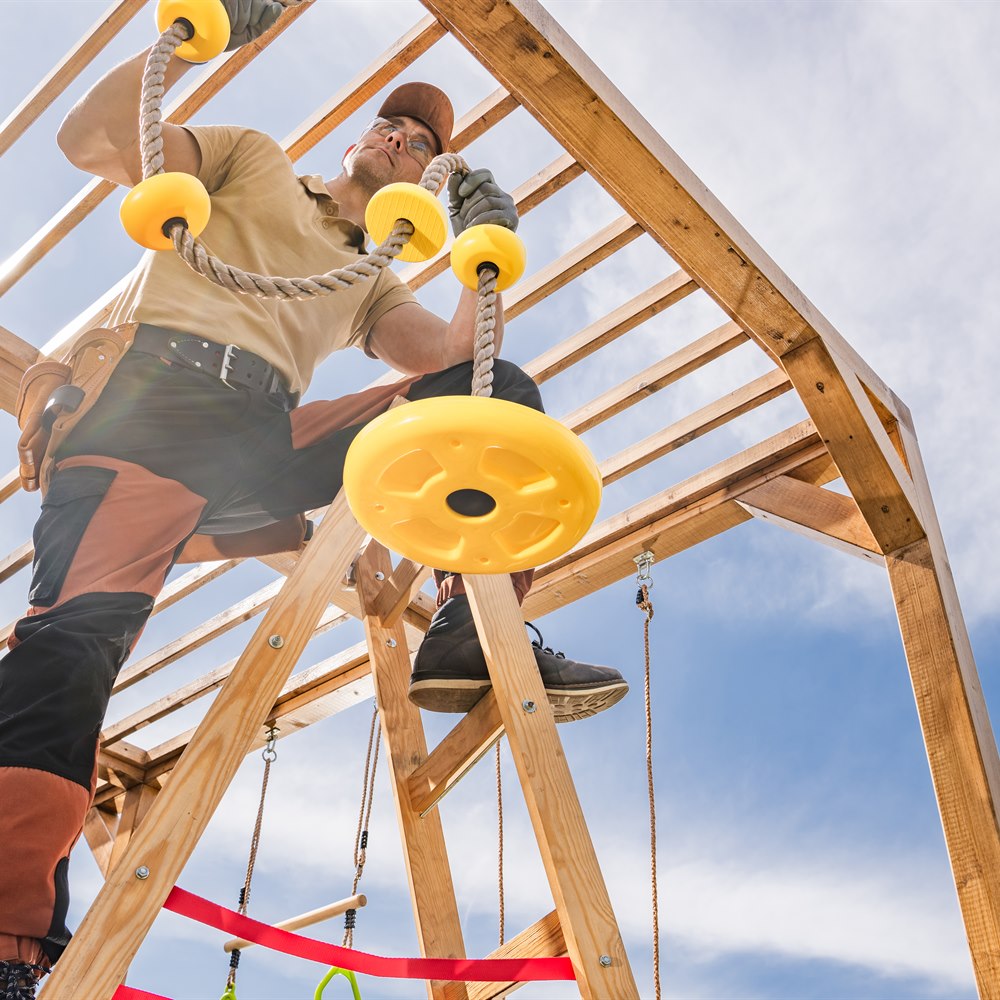
Many playsets are sold as kits that include assembly as a separate cost. Professional assembly runs $700 to $900 for most mid-range structures, more for large or complex ones, which is what a retailer adds over its do-it-yourself price — the same Gorilla Outing III lists at $899 to build yourself and $1,590 to $1,811 assembled. While some families choose DIY assembly, large wooden playsets with many components take eight to twelve hours for an inexperienced crew, and improperly assembled structures create safety risks. Professional installers complete the job in a fraction of the time and ensure anchoring and hardware are done correctly.
Anchoring Systems
Swing sets and playsets need to be anchored to prevent tipping during vigorous use. Anchoring systems vary from basic screw-in ground anchors included with the set to concrete footings for larger structures. Properties with sandy or soft soil may require more robust anchoring than standard kits include. Confirming that the installation includes appropriate anchoring for your soil conditions prevents a stability problem after installation.
Ongoing Maintenance for Wood Structures
Wooden playsets require periodic maintenance: sanding to prevent splinters, sealing or staining every one to two years to protect from moisture and UV, and hardware inspection and tightening annually. These costs aren’t large individually but they’re ongoing and start the first year after installation. A playset that isn’t maintained develops rough surfaces, begins to gray and check, and can develop structural deterioration within a few years.
How Much Safety Surfacing Actually Costs
Safety surfacing is the hidden cost that most consistently surprises homeowners, because the volume of material required is larger than intuition suggests. A mid-range playset with a safety zone extending 6 feet beyond the equipment footprint in all directions, which is the minimum recommendation for most residential structures, might cover an area of 400 to 600 square feet at a depth of several inches. Surfacing is quoted by the square foot rather than by the job: engineered wood fiber runs $3 to $5 per square foot installed, rubber mulch $6 to $10, rubber tiles $12 to $21, and poured-in-place rubber $20 to $27, and building a base up from bare ground adds $5 to $10 per square foot on top. Adding lumber or rubber edging to contain the material adds further. Across a full safety zone that makes surfacing the largest single line in most backyard playground projects, larger than the equipment itself and far larger than the assembly labor, which surprises families who discover it after budgeting only for the equipment. (For more on this, see Playground Equipment Safety: What Every Parent Should Know.)
The Replacement Cycle for Safety Surfacing
Safety surfacing is not just an upfront cost; it is an ongoing one. Wood-based materials like engineered wood fiber and wood chips decompose over time and need replenishment every one to two years to maintain the appropriate depth for fall protection. Rubber mulch lasts significantly longer but still requires occasional topping up. Poured rubber surfaces are permanent but eventually show wear and may need sections replaced. Building annual or biennial surfacing replenishment into the play space maintenance budget gives a realistic picture of the ongoing cost, which is modest per year but not zero.
Keeping Costs Predictable
Budget for site preparation, safety surfacing, installation, appropriate anchoring, and first-year maintenance alongside the equipment price. When you’re ready for a complete quote including all components, connect with local pros below.
The complete picture: equipment cost plus assembly ($700 to $900), safety surfacing (priced per square foot, from $3 to $5 installed for engineered wood fiber up to $20 to $27 for poured-in-place rubber, plus $5 to $10 per square foot for a base from bare ground), site prep if needed, and year-one maintenance supplies. Budgeting this total upfront is what makes the project go smoothly from delivery to first use.
Asking for a complete cost estimate covering equipment, installation, surfacing, and site prep from any installer you consider is the most efficient way to make these hidden costs visible before you commit rather than after.
Cost figures on this page were checked against published pricing on August 24, 2026. How we source cost data.
Frequently Asked Questions
Safety surfacing. Wood mulch, engineered wood fiber, or rubber surfacing under and around equipment is strongly recommended for safety and adds meaningful cost. The safety zone extends beyond the equipment footprint and is quoted by the square foot rather than by the job: $3 to $5 per square foot installed for engineered wood fiber, $6 to $10 for rubber mulch, $12 to $21 for rubber tiles, and $20 to $27 for poured-in-place rubber, plus $5 to $10 per square foot to build a base from bare ground. This is one of the most commonly overlooked items in backyard playground planning.
It's strongly recommended, especially for mid-range and larger wooden structures. Professional assembly runs $700 to $900 and ensures correct assembly, proper anchoring, and safety hardware tightening. DIY assembly of large wooden sets takes 8 to 12 hours, and improperly assembled or anchored structures create real safety risks.
Yes. Swing sets and playsets need anchoring to prevent tipping during vigorous use. Anchoring systems range from screw-in ground anchors to concrete footings for larger structures. Properties with sandy or soft soil may require more robust anchoring than standard kits include. Confirm appropriate anchoring for your soil conditions.
Reasonably so. If the intended location slopes significantly, site preparation (grading or leveling) adds cost before equipment installation. This ranges from a minor adjustment to significant earthwork depending on terrain. Clearing roots, debris, or landscaping conflicting with the footprint is also additional labor.
Annual hardware inspection and tightening, sanding to prevent splinters, and sealing or staining every one to two years to protect from moisture and UV. An unmaintained wood playset grays, checks, and can develop structural deterioration within a few years. These costs are modest individually but ongoing from the first year.