What Happens During Cabinet and Countertop Installation?
Cabinets go in over 1 to 3 days, the countertop is templated right after, and fabrication takes another 1 to 2 weeks before the countertop is installed. Understanding that sequence prevents scheduling surprises and helps you plan for the kitchen downtime.
Cabinet Installation
Upper cabinets are installed before base cabinets (so the upper cabinet installer is not working over the base cabinets). The installation begins by locating studs and establishing a level reference line. Upper cabinets are hung on the wall on the reference line. Base cabinets are installed next, shimmed level, and secured to the wall studs. A skilled cabinet installer makes the cabinets look built-in — doors aligned, gaps consistent, and drawer fronts plumb and level. Installation time: 1 to 3 days for a standard kitchen, depending on the number of cabinets and the complexity of the layout. After cabinet installation: a countertop template is made.
Countertop Templating and Fabrication
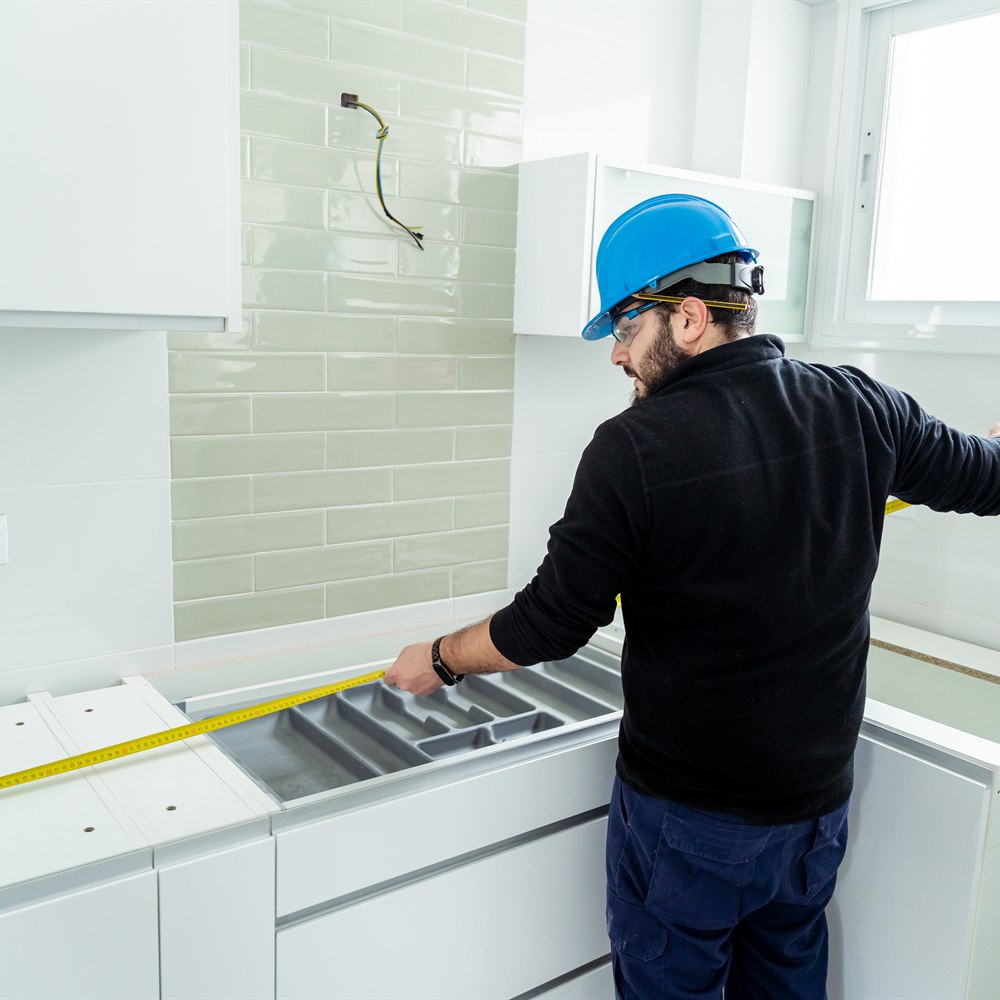
After cabinet installation: a countertop fabricator visits the site to create a precise template of the countertop layout. The template captures the exact dimensions, the sink cutout location, any angle cuts, and the edge profile at each section. Templating: 1 to 2 hours on-site. Fabrication (cutting, polishing the edges, and finishing the slab to the template dimensions): typically 1 to 2 weeks at the fabricator’s shop. The kitchen is functional with a temporary countertop (plywood) or not functional during the fabrication period. Plan for eating elsewhere or a temporary kitchen setup during this time. (For more on this, see How to Plan a Kitchen Renovation: Cabinets and Countertops.)
Countertop Installation
The fabricated countertop is delivered and installed by the fabricator’s team (not the cabinet installer — a different contractor). Stone countertops are extremely heavy (quartz and granite at 1.25 inches thick: 18 to 20 lbs per sq ft). A 30-sq-ft countertop section: 540 to 600 lbs — requires 2 to 4 installers and specialized handling equipment. Installation day: the countertop is dry-fit, the sink is mounted (undermount sinks are mounted from below and secured with epoxy and clips), and the countertop is secured to the cabinet with silicone adhesive. The kitchen is usable 24 hours after installation (time for the silicone to cure). (For more on this, see How Long Does a Cabinet and Countertop Installation Take?.)
Working With a Contractor on This Project
Getting the right outcome on any home services project starts before the work begins. A few consistent practices make the difference between a smooth project and a frustrating one.
Get at least two or three quotes. A single quote gives you no basis for comparison. Two or three quotes reveal the market rate for the work, expose scope differences between bidders, and let you assess contractor communication quality before any commitment is made. The lowest bid is not automatically the best value if the scope is thin or the materials are underspecified. (For more on this, see Kitchen Countertop Materials: Full Comparison.)
Ask for licenses and insurance before work starts. Verify current general liability insurance and, for any work involving workers on your property, workers compensation coverage. Licensing requirements vary by state and trade; confirm the specific requirements in your jurisdiction. A licensed contractor who carries appropriate insurance protects both parties if something goes wrong during the project.
Get the scope in writing. A written proposal that specifies materials, labor scope, timeline, what is included (permits, cleanup, disposal), and warranty terms is the foundation of a professional engagement. Verbal agreements on any of these points invite misunderstanding. For any project over $500, written scope is non-negotiable.
Clarify the payment schedule upfront. A reasonable payment schedule ties major payments to project milestones: a deposit at signing, a payment at material delivery or project start, and a final payment at completion after a walkthrough confirms satisfaction. A contractor who requires full payment upfront before work begins is a red flag in any trade.
Making a Confident Decision
The information in this article is designed to help you ask better questions of the professionals you work with, evaluate their answers with more confidence, and understand the decisions involved in this type of home services project. It is not a substitute for professional assessment of your specific home.
Every home is different. Roof slopes, local weather, tree exposure, soil conditions, and existing system condition all affect what the right solution is for your specific situation. The general principles here apply broadly, but a professional who assesses your home in person will give you guidance that accounts for the details that general articles cannot.
When you are ready to move forward, getting at least two or three quotes from licensed, insured, local contractors is the most important practical step. It lets you compare approaches, assess contractor quality, and confirm that the solution proposed matches your specific situation and budget.
Cabinets and Countertops Cost at a Glance
Stock cabinets: $100 to $400 per linear foot installed, available off-the-shelf. Semi-custom cabinets: $250 to $850 per linear foot installed, 3 to 8-week lead time, the most popular mid-range choice. Custom cabinets: $500 to $1,200+ per linear foot, 8 to 16-week lead time, built to any specification. Cabinet refacing (keeping existing boxes, replacing doors and veneers): $8,000 to $16,000 for an average-sized kitchen, 40 to 60 percent less than full replacement when boxes are structurally sound.
Laminate countertops: $20 to $50 per sq ft installed. Quartz: $60 to $120 per sq ft, non-porous and no sealing required. Granite: $60 to $130 per sq ft, fully heat-resistant, annual sealing required. A full mid-range kitchen renovation (semi-custom cabinets plus quartz countertops): $40,000 to $90,000. Cabinet plus countertop costs are typically 50 to 60 percent of a kitchen renovation budget.
Cost figures on this page were checked against published pricing on August 29, 2026. How we source cost data.
Frequently Asked Questions
1 to 3 days for a standard kitchen cabinet installation (upper and base cabinets). More complex layouts (corner cabinets, tall pantry units, a large island) add time. Countertop templating happens the day after cabinet installation.
Template: 1 to 2 hours on-site. Fabrication: 1 to 2 weeks at the fabricator's shop. Delivery and installation: 2 to 4 hours. Total from template to installed countertop: 1 to 2 weeks. The kitchen is non-functional for countertop removal and installation day (usually 1 day). Plan meals accordingly.
An undermount sink is mounted from below the countertop, with the edge of the countertop overlapping the sink rim (rather than the sink rim sitting on top of the countertop as in a drop-in or self-rimming sink). The undermount configuration provides a cleaner appearance (no rim to harbor bacteria around the sink edge), easier counter-to-sink sweeping during cleaning, and a more contemporary look. It requires a stone or solid countertop material (quartz, granite, solid surface) -- laminate cannot support an undermount sink without the front edge delaminating.
Usually yes -- the countertop fabricator cuts the sink hole, mounts the undermount sink from below (with epoxy and clips), and delivers the countertop with the sink already mounted. The plumber connects the sink to the supply lines and drain after countertop installation. For drop-in sinks: the plumber or homeowner can install after countertop installation.
Remove all items from existing cabinets and store them elsewhere. Clear the kitchen of furniture and portable appliances. Confirm all cabinets have arrived and have been inspected for damage before the installation day. Confirm the installation crew has access to the home and knows the parking situation. Have the countertop fabricator scheduled to template 1 to 2 days after cabinet installation is complete.