
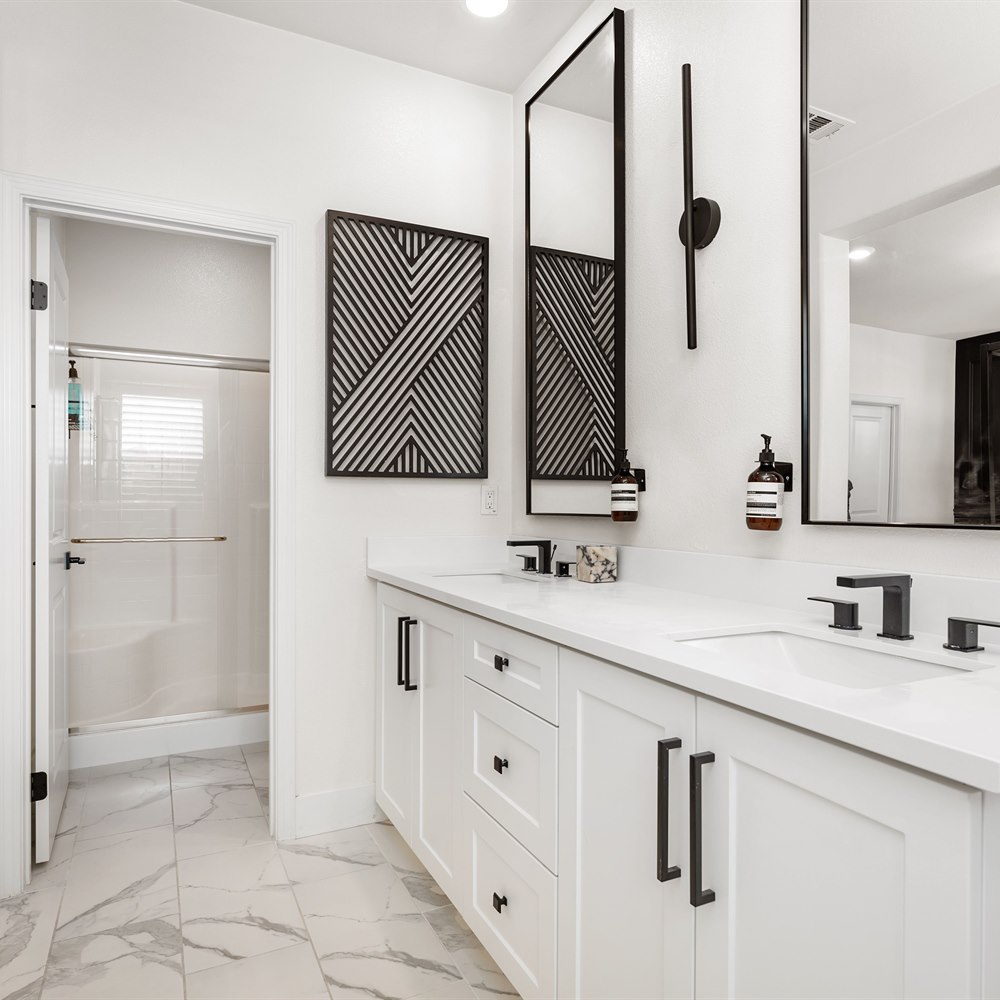
What Does a Bathroom Remodel Cost?
A bathroom remodel typically costs $18,000 to $35,000 for a mid-range update with new fixtures, tile, and vanity, with the 2025 national average for that scope at $26,138. The scope of work is the primary cost driver.
Basic Refresh: $5,000 to $12,000
A basic bathroom refresh — new fixtures, updated paint, new flooring, and a refreshed vanity — stays in this range when the layout does not change and existing plumbing connections are reused. This scope suits a functional bathroom where the primary goal is improved appearance rather than complete transformation. Swapping a vanity, replacing a toilet, installing new flooring, painting, and updating light fixtures can transform the look of a dated bathroom at costs well below a full remodel. The key constraint: no plumbing relocation, no tile replacement, no tub or shower replacement.
Mid-Range Remodel: $18,000 to $35,000
A mid-range remodel includes new tub or shower, full tile replacement on floor and walls, a new vanity with solid-surface countertop, new lighting and ventilation fan, and updated fixtures throughout. This scope involves opening walls for new tile backer, potentially updating the shower pan, and replacing most visible finishes. The tile work alone accounts for $2,000 to $5,000 of a mid-range bathroom remodel — material, installation, and grout on a 60 to 100-square-foot tiled area. Labor for a full bathroom tile job from a skilled tile setter: $10 to $20 per square foot. (For more on this, see What Affects Bathroom Remodel Cost?.)
High-End or Master Bath Remodel: $35,000 to $80,000
Premium fixtures, custom tile work, a freestanding soaking tub, a walk-in shower with frameless glass enclosure, radiant floor heating, or a layout change that requires moving plumbing push costs above $35,000. Custom vanity cabinetry at $500 to $2,000 per linear foot, heated floors at $10 to $20 per square foot installed, and frameless glass shower enclosures at $1,200 to $3,000 each are the typical premium items. A master bath remodel with all premium finishes in a large bathroom: $35,000 to $80,000, and a luxury primary suite runs beyond that at $400 to $600 per square foot. (For more on this, see Bathroom Remodel ROI: What Adds Value and What Doesn’t.)
Bathroom Remodel Cost at a Glance
| Cost Factor | Typical Range | Notes |
|---|---|---|
| Basic refresh (fixtures, vanity, paint, flooring, no tile or layout change) | $5,000 to $12,000 | Roughly $80 to $120 per square foot turnkey. |
| Mid-range remodel (new tub or shower, tile, vanity, flooring, lighting, same plumbing footprint) | $18,000 to $35,000 | $150 to $250 per square foot; 2025 national average $26,138. The tub or shower swap alone runs $10,000 to $18,000. |
| Upscale or primary bath (custom tile, premium fixtures, layout changes) | $35,000 to $80,000 | $250 to $400 per square foot; a luxury primary suite runs beyond this at $400 to $600. |
| Overall range | $18,000 to $35,000 | , averaging $26,138 for a mid-range full bathroom remodel |
Cost figures on this page were checked against published pricing on August 28, 2026. How we source cost data.
Planning Your Project Budget
The cost ranges in this article are based on industry data and are intended as planning benchmarks, not fixed prices. The actual cost for your project depends on your specific home, your local labor market, the current price of materials, and the scope the contractor confirms after a site inspection.
Always get at least two written quotes on equivalent defined scope before committing to any home services project. Wide price variation between quotes usually reflects differences in material quality, scope completeness (what is included and what is not), or contractor overhead and experience level rather than simple price competition.
Use the cost data in this article to ask better questions during the quoting process: What material is included? What does that per-square-foot or per-linear-foot rate include and exclude? Are permits, cleanup, and disposal included? What is the warranty on labor? These questions turn a quote into a comparable basis for decision-making.
Working With a Contractor on This Project
Getting the right outcome on any home services project starts before the work begins. A few consistent practices make the difference between a smooth project and a frustrating one.
Get at least two or three quotes. A single quote gives you no basis for comparison. Two or three quotes reveal the market rate for the work, expose scope differences between bidders, and let you assess contractor communication quality before any commitment is made. The lowest bid is not automatically the best value if the scope is thin or the materials are underspecified.
Ask for licenses and insurance before work starts. Verify current general liability insurance and, for any work involving workers on your property, workers compensation coverage. Licensing requirements vary by state and trade; confirm the specific requirements in your jurisdiction. A licensed contractor who carries appropriate insurance protects both parties if something goes wrong during the project.
Get the scope in writing. A written proposal that specifies materials, labor scope, timeline, what is included (permits, cleanup, disposal), and warranty terms is the foundation of a professional engagement. Verbal agreements on any of these points invite misunderstanding. For any project over $500, written scope is non-negotiable.
Clarify the payment schedule upfront. A reasonable payment schedule ties major payments to project milestones: a deposit at signing, a payment at material delivery or project start, and a final payment at completion after a walkthrough confirms satisfaction. A contractor who requires full payment upfront before work begins is a red flag in any trade.