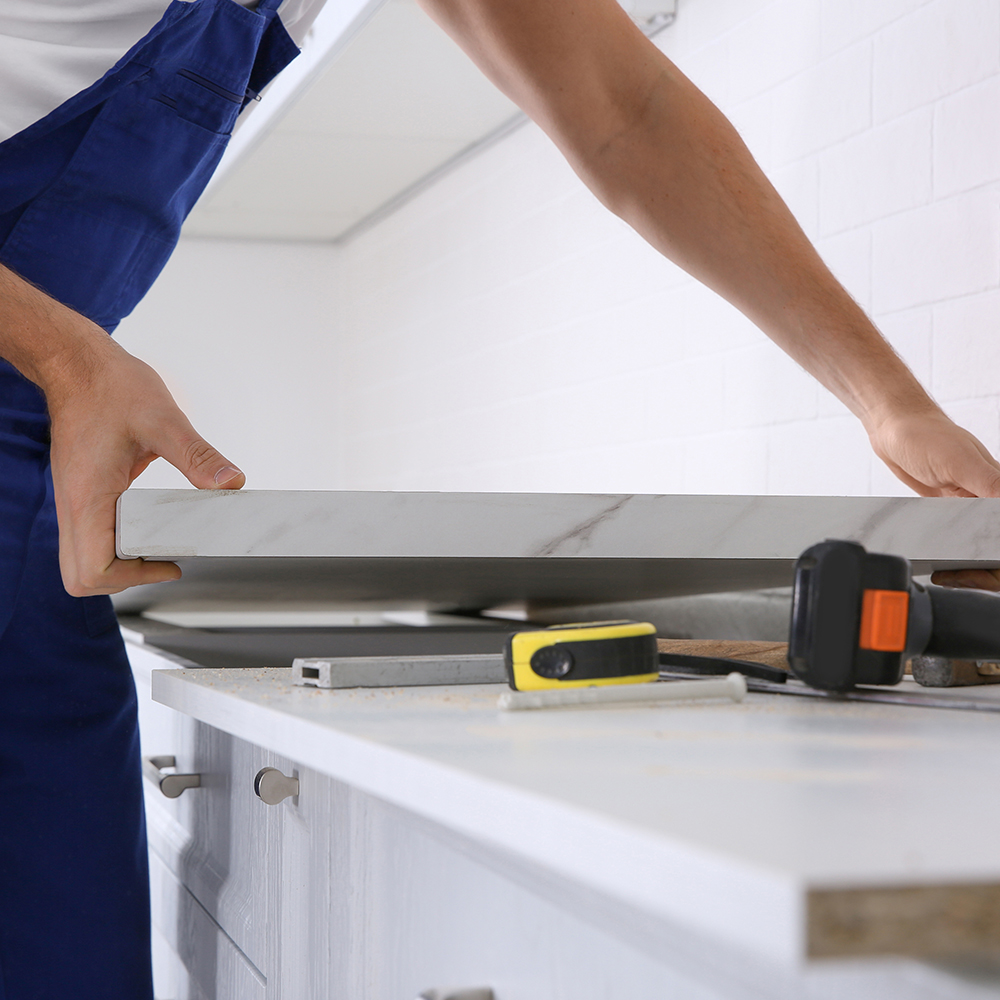
Which Countertop Material Is Right for Your Kitchen?
The most popular countertop materials each have distinct advantages and trade-offs. Here is how to choose.
Quartz: Most Practical for Active Kitchens
Quartz (engineered stone, manufactured from quartz aggregate and resin): the most popular countertop material in new kitchen installations. Non-porous (requires no annual sealing), more consistent in color and pattern than natural stone, highly resistant to staining, and available in designs that closely mimic marble, granite, and concrete. The primary limitation: the resin binders are not fully heat-proof — a very hot pan set directly on quartz can discolor or crack the surface at the resin bond. Always use trivets or hot pads with quartz. Premium quartz brands (Cambria, Caesarstone, Silestone): offer warranties of 10 to 25 years.
Granite: Best Heat Resistance, Unique per Slab
Granite (natural quarried stone): completely heat-resistant (you can set a hot pan directly on granite without damage), each slab is unique in color and veining pattern (which can be an advantage or a challenge for matching), and extremely durable. The limitation: granite is porous and must be sealed annually (or biennially with a quality penetrating sealer) to prevent staining from acidic liquids (wine, citrus, coffee). An unsealed or improperly sealed granite: stains permanently in high-use kitchens. Service life: effectively indefinite with proper sealing maintenance.
Marble: Most Elegant, Most Maintenance
Marble (natural metamorphic limestone): provides an unmatched elegance and a natural veining that no engineered product perfectly replicates. Marble is the traditional choice for baking surfaces (cool and smooth). The limitations: marble is the most porous and most etching-sensitive of the three (acidic foods and cleaners etch the surface, creating dull spots). Marble in a high-use kitchen requires a honed finish (which hides etching better than polished) and rigorous sealing and surface protection. Best for: homeowners who love the marble aesthetic and are committed to the care it requires, or for use in lower-traffic areas (a butler’s pantry, a bar top).
Working With a Contractor on This Project
Getting the right outcome on any home services project starts before the work begins. A few consistent practices make the difference between a smooth project and a frustrating one.
Get at least two or three quotes. A single quote gives you no basis for comparison. Two or three quotes reveal the market rate for the work, expose scope differences between bidders, and let you assess contractor communication quality before any commitment is made. The lowest bid is not automatically the best value if the scope is thin or the materials are underspecified.
Ask for licenses and insurance before work starts. Verify current general liability insurance and, for any work involving workers on your property, workers compensation coverage. Licensing requirements vary by state and trade; confirm the specific requirements in your jurisdiction. A licensed contractor who carries appropriate insurance protects both parties if something goes wrong during the project.
Get the scope in writing. A written proposal that specifies materials, labor scope, timeline, what is included (permits, cleanup, disposal), and warranty terms is the foundation of a professional engagement. Verbal agreements on any of these points invite misunderstanding. For any project over $500, written scope is non-negotiable.
Clarify the payment schedule upfront. A reasonable payment schedule ties major payments to project milestones: a deposit at signing, a payment at material delivery or project start, and a final payment at completion after a walkthrough confirms satisfaction. A contractor who requires full payment upfront before work begins is a red flag in any trade.
Making a Confident Decision
The information in this article is designed to help you ask better questions of the professionals you work with, evaluate their answers with more confidence, and understand the decisions involved in this type of home services project. It is not a substitute for professional assessment of your specific home.
Every home is different. Roof slopes, local weather, tree exposure, soil conditions, and existing system condition all affect what the right solution is for your specific situation. The general principles here apply broadly, but a professional who assesses your home in person will give you guidance that accounts for the details that general articles cannot.
When you are ready to move forward, getting at least two or three quotes from licensed, insured, local contractors is the most important practical step. It lets you compare approaches, assess contractor quality, and confirm that the solution proposed matches your specific situation and budget.
Cabinets and Countertops Cost at a Glance
Stock cabinets: $60 to $150 per linear foot installed, available off-the-shelf. Semi-custom cabinets: $100 to $650 per linear foot installed, 3 to 8-week lead time, the most popular mid-range choice. Custom cabinets: $500 to $1,200+ per linear foot, 8 to 16-week lead time, built to any specification. Cabinet refacing (keeping existing boxes, replacing doors and veneers): $5,000 to $12,000 for most kitchens, 40 to 60 percent less than full replacement when boxes are structurally sound.
Laminate countertops: $20 to $50 per sq ft installed. Quartz: $60 to $120 per sq ft, non-porous and no sealing required. Granite: $60 to $130 per sq ft, fully heat-resistant, annual sealing required. A full mid-range kitchen renovation (semi-custom cabinets plus quartz countertops): $25,000 to $50,000. Cabinet plus countertop costs are typically 50 to 60 percent of a kitchen renovation budget.
Frequently Asked Questions
Quartz: the most durable for stain resistance and consistency. Granite: the most heat-resistant and scratch-resistant natural stone. Quartzite (a natural stone, harder than granite): the hardest and most scratch-resistant natural stone option. Marble: the least durable for active kitchen use (etches and stains more readily than granite or quartz). For a high-use family kitchen: quartz or granite.
Quartz is more stain-resistant than natural stone because it is non-porous (no annual sealing required). However: extremely prolonged exposure to dark liquids (red wine, coffee, beet juice) can stain the resin-binder component. Immediate cleanup of spills is still important with quartz. Strong alkaline cleaners (bleach, strong degreasers): can break down the resin binders and dull the surface. Use pH-neutral cleaners for quartz maintenance.
Yes -- granite is a porous natural stone that should be sealed annually (or biennially with a quality penetrating sealer). The water test: pour a tablespoon of water on the granite surface and wait 5 minutes. If the water beads: the sealer is still effective. If the water darkens the stone (absorbs into the surface): resealing is needed. Neglecting to seal granite allows wine, coffee, and acidic liquids to penetrate and permanently stain the stone.
Quartzite is a natural metamorphic stone (formed from sandstone under heat and pressure) -- it looks like marble but is harder and more resistant to etching. Quartz is an engineered product (manufactured from quartz aggregate and resin). Quartzite: beautiful natural marble-like patterns, very hard, requires sealing like granite. Quartz: consistent engineered patterns, non-porous (no sealing), slightly less heat-resistant. The names are easily confused in countertop showrooms -- always confirm which product you are looking at.
Marble: traditionally preferred for baking because it stays naturally cool (important for pastry work) and the smooth surface is easy to flour and roll dough on. Granite: also cool and smooth -- a practical alternative to marble at potentially lower maintenance cost. Quartzite: similar properties to marble with better stain resistance. For a dedicated baking station in a kitchen: a marble or granite section provides the best working surface.