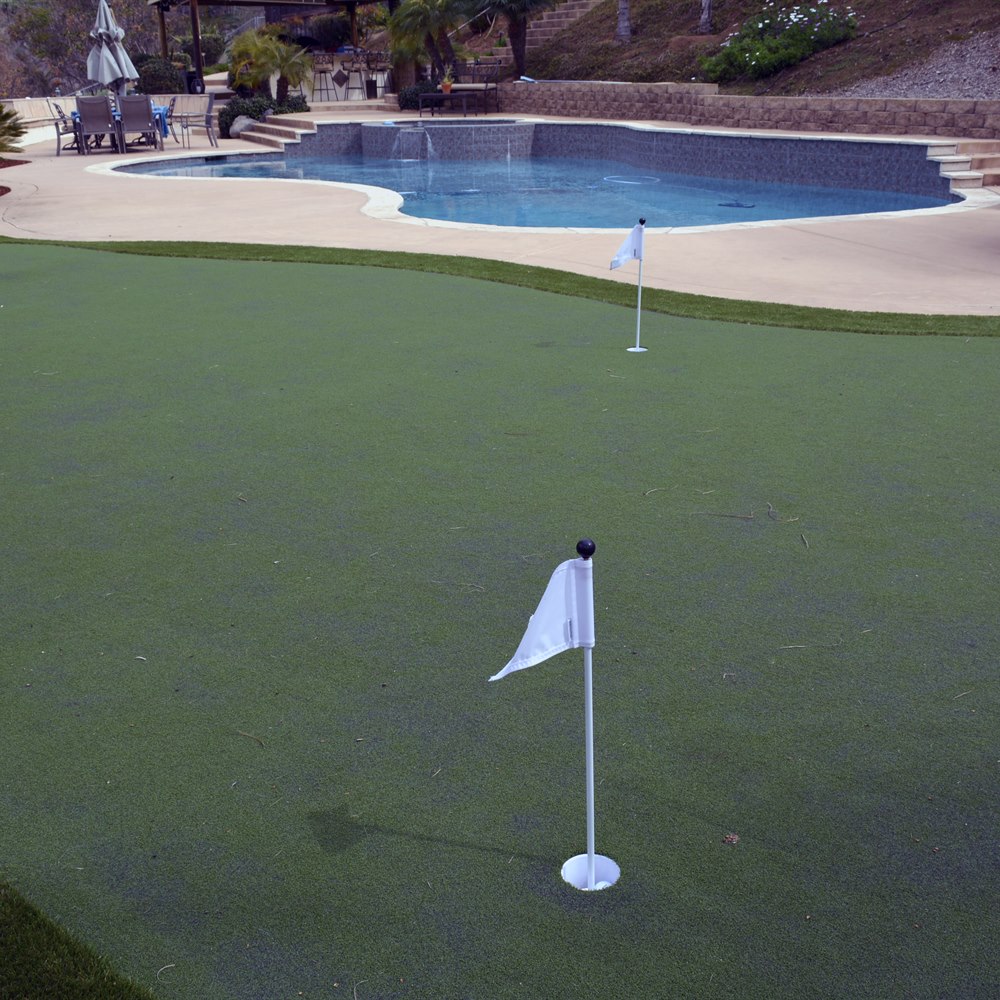

How Do You Maintain a Backyard Putting Green?
Brush the surface weekly to monthly, clear debris after every session, top dress annually with 1 to 2 pounds of fine silica sand per square foot, and rotate the cups. That modest routine keeps a properly installed putting green playing fast and true — light brushing takes about 10 minutes per 300 square feet.
Brushing: Weekly to Monthly
The nylon blades of a putting green lie down over time in the direction of predominant play. Blades lying in the grain direction produce slower putt speed (the ball rolls into the grain); blades lying against the grain produce faster speed. Brushing the surface against the predominant grain direction lifts the blades and restores a more uniform surface speed. Light brushing with a stiff push broom: 10 minutes per 300 square feet. Heavy-traffic areas (around the cup, at the primary putting position) benefit from more frequent brushing than the perimeter. (For more on this, see How Much Does a Backyard Putting Green Cost?.)
Debris Removal After Each Use
Leaves, organic debris, and dirt tracked onto the green surface affect ball roll immediately. A leaf blower clears most debris in 2 to 5 minutes. Any organic material left on the green surface can stain the turf over time and eventually provide a growing medium for weed seeds. Inspect the green after windy weather and remove debris before the next practice session.
Top Dressing: Annually
Sand infill settles and migrates over time on a putting green surface. An annual light top dressing — adding fresh fine sand topping at 1 to 2 pounds per square foot and brushing it into the blades — restores the proper infill level and maintains blade support. The correct sand for top dressing: the same specification as the original infill (silica topping sand, not coarse construction sand). Apply when the turf is dry, spread evenly, and brush thoroughly into the pile. (For more on this, see Hidden Costs of a Backyard Putting Green.)
Cup Rotation
The area around each cup receives the most foot traffic on the green — multiple players putting to the same cup create a compacted, flattened area around the hole. Rotating the cups periodically (installing the cup liner at a different location in the pre-cut positions, or cutting a new position) distributes wear across the green surface rather than concentrating it at fixed locations. Most greens have 3 to 6 cut positions that can be rotated through over a season. Cup rotation extends the visual life of the green by preventing permanent compression marks around fixed cup positions. (For more on this, see Questions to Ask Before Installing a Backyard Putting Green.)
Working With a Contractor on This Project
Getting the right outcome on any home services project starts before the work begins. A few consistent practices make the difference between a smooth project and a frustrating one.
Get at least two or three quotes. A single quote gives you no basis for comparison. Two or three quotes reveal the market rate for the work, expose scope differences between bidders, and let you assess contractor communication quality before any commitment is made. The lowest bid is not automatically the best value if the scope is thin or the materials are underspecified.
Ask for licenses and insurance before work starts. Verify current general liability insurance and, for any work involving workers on your property, workers compensation coverage. Licensing requirements vary by state and trade; confirm the specific requirements in your jurisdiction. A licensed contractor who carries appropriate insurance protects both parties if something goes wrong during the project.
Get the scope in writing. A written proposal that specifies materials, labor scope, timeline, what is included (permits, cleanup, disposal), and warranty terms is the foundation of a professional engagement. Verbal agreements on any of these points invite misunderstanding. For any project over $500, written scope is non-negotiable.
Clarify the payment schedule upfront. A reasonable payment schedule ties major payments to project milestones: a deposit at signing, a payment at material delivery or project start, and a final payment at completion after a walkthrough confirms satisfaction. A contractor who requires full payment upfront before work begins is a red flag in any trade.
Making a Confident Decision
The information in this article is designed to help you ask better questions of the professionals you work with, evaluate their answers with more confidence, and understand the decisions involved in this type of home services project. It is not a substitute for professional assessment of your specific home.
Every home is different. Roof slopes, local weather, tree exposure, soil conditions, and existing system condition all affect what the right solution is for your specific situation. The general principles here apply broadly, but a professional who assesses your home in person will give you guidance that accounts for the details that general articles cannot.
When you are ready to move forward, getting at least two or three quotes from licensed, insured, local contractors is the most important practical step. It lets you compare approaches, assess contractor quality, and confirm that the solution proposed matches your specific situation and budget.
Ranges here are national ballpark figures, not quotes. Actual pricing varies by region, home condition, materials, and contractor. How we source cost data.