
Should You Fertilize Your Lawn Yourself or Hire a Professional?
Lawn fertilization is one of the more DIY-accessible lawn care services the equipment is inexpensive and the products are readily available. Here is the honest cost-benefit comparison.
DIY Fertilization Cost
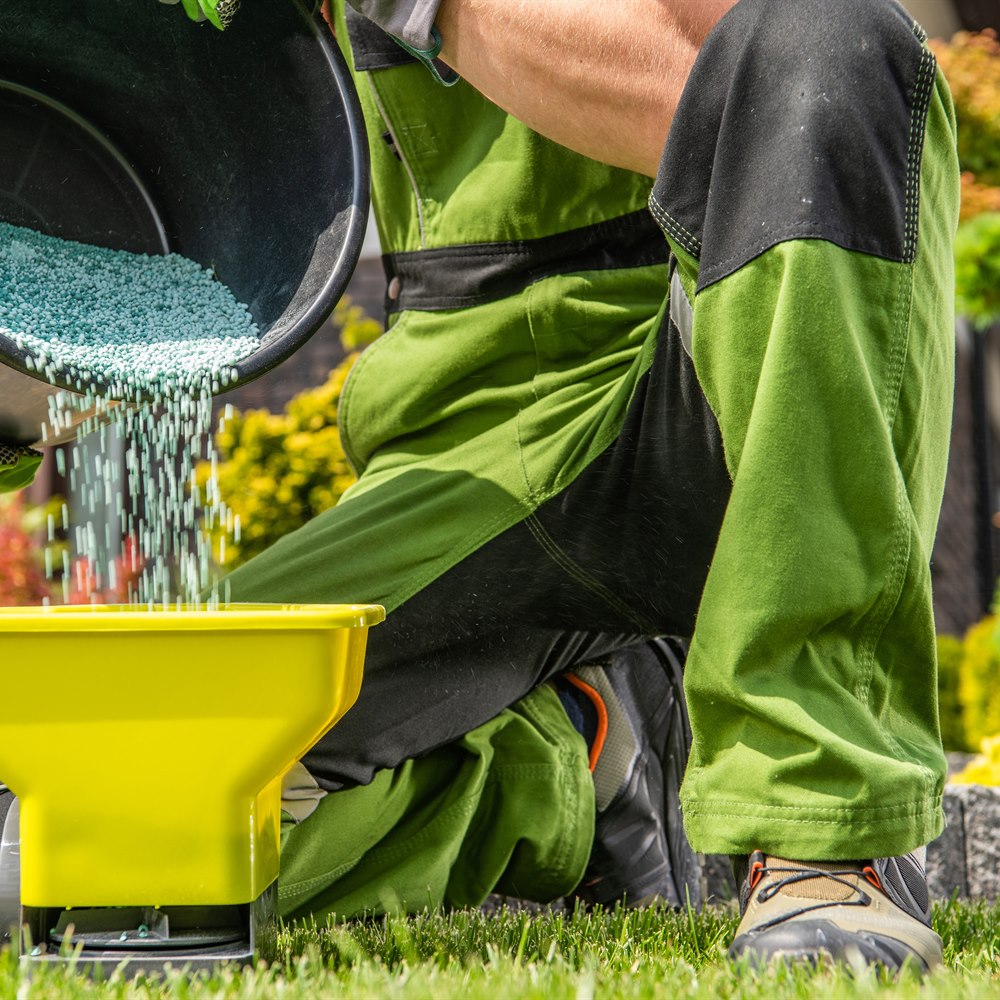
A walk-behind broadcast spreader costs $65 to $150. Handheld and hand-crank spreaders run $35 to $45, but they are slower and harder to calibrate on a full lot. A 50-pound bag of granular slow-release fertilizer for 15,000 square feet costs $30 to $80. A soil test costs $15 to $30. Total first-year DIY cost for 4 applications on an average lot: $185 to $370 including equipment. In subsequent years: $80 to $150 in materials only. This compares to $300 to $800 annually for professional service on the same lot.
What DIY Fertilization Requires
Reading a soil test and selecting the right fertilizer analysis (N-P-K ratio) for your grass type and season. Calibrating the spreader correctly to the product’s recommended application rate. Applying at the correct time of year for your grass type. Watering correctly after application. Knowing when not to fertilize (drought, disease outbreak, extreme heat). These are learnable skills but require more engagement than hiring a professional. (For more on this, see Lawn Fertilizer Application Mistakes to Avoid.) EPA WaterSense recommends about one inch of water a week, avoiding midday watering, and weather-based controllers to cut waste.
When Professional Service Is Worth the Premium
Complex lawns with multiple grass types, significant weed pressure requiring herbicide treatment, or soil conditions needing ongoing amendments benefit from professional management. Homeowners without the time to research the program, purchase supplies, and apply at the right times get consistent results from professional programs without the management overhead. Professionals also carry the liability for product safety if a licensed company applies a herbicide incorrectly, the liability is theirs, not the homeowner’s.
Working With a Contractor on This Project
Getting the right outcome on any home services project starts before the work begins. A few consistent practices make the difference between a smooth project and a frustrating one.
Get at least two or three quotes. A single quote gives you no basis for comparison. Two or three quotes reveal the market rate for the work, expose scope differences between bidders, and let you assess contractor communication quality before any commitment is made. The lowest bid is not automatically the best value if the scope is thin or the materials are underspecified.
Ask for licenses and insurance before work starts. Verify current general liability insurance and, for any work involving workers on your property, workers compensation coverage. Licensing requirements vary by state and trade; confirm the specific requirements in your jurisdiction. A licensed contractor who carries appropriate insurance protects both parties if something goes wrong during the project.
Get the scope in writing. A written proposal that specifies materials, labor scope, timeline, what is included (permits, cleanup, disposal), and warranty terms is the foundation of a professional engagement. Verbal agreements on any of these points invite misunderstanding. For any project over $500, written scope is non-negotiable.
Clarify the payment schedule upfront. A reasonable payment schedule ties major payments to project milestones: a deposit at signing, a payment at material delivery or project start, and a final payment at completion after a walkthrough confirms satisfaction. A contractor who requires full payment upfront before work begins is a red flag in any trade.
Making a Confident Decision
The information in this article is designed to help you ask better questions of the professionals you work with, evaluate their answers with more confidence, and understand the decisions involved in this type of home services project. It is not a substitute for professional assessment of your specific home.
Every home is different. Roof slopes, local weather, tree exposure, soil conditions, and existing system condition all affect what the right solution is for your specific situation. The general principles here apply broadly, but a professional who assesses your home in person will give you guidance that accounts for the details that general articles cannot.
When you are ready to move forward, getting at least two or three quotes from licensed, insured, local contractors is the most important practical step. It lets you compare approaches, assess contractor quality, and confirm that the solution proposed matches your specific situation and budget.
Lawn Fertilization Cost at a Glance
| Cost Factor | Typical Range | Notes |
|---|---|---|
| Single application (small lawn) | $47 to $90 per application, including material and labor | Most crews hold a minimum of about $47 to $50 a treatment, and a one-off visit runs up to 30 percent above program rates. |
| Larger lawn or premium product | $150 to $405 per application | A one-acre lawn runs $260 to $340 a treatment. |
| Weed control add-on | $50 to $210 additional per treatment | Priced by lot size; most season-long programs already bundle blanket broadleaf treatments. |
| Annual program (5 to 7 applications) | $300 to $500 per year for a 5,000 to 10,000 sq ft lawn | $400 to $900 a year for premium or larger-lawn programs. This is what most homeowners actually buy. |
| Overall range | $47 to $405 per application, averaging $70 |
Cost figures on this page were checked against published pricing on August 29, 2026. How we source cost data.