What Are the Most Common Sprinkler System Problems?
Dry spots almost always mean a failed head — $8 to $25 per head plus $50 to $100 in labor — while wet spots mean a leak or a valve that will not close, and low pressure across every zone points to the main supply. Irrigation system problems show up in the lawn before they show up in the equipment, and most fall into a handful of categories with straightforward causes.
Start every diagnosis with one question: does the problem affect one zone or all of them? A single-zone problem almost always points to that zone’s valve, wiring, or heads. A multi-zone problem points to the controller or the main supply. Running each zone manually from the controller while you walk the system narrows the cause considerably before you pick up a tool. (For more on this, see Sprinkler System Maintenance: What to Do Each Year.) EPA WaterSense recommends about one inch of water a week, avoiding midday watering, and weather-based controllers to cut waste.
Problems You Can See in the Lawn
Dry Spots and Poor Coverage
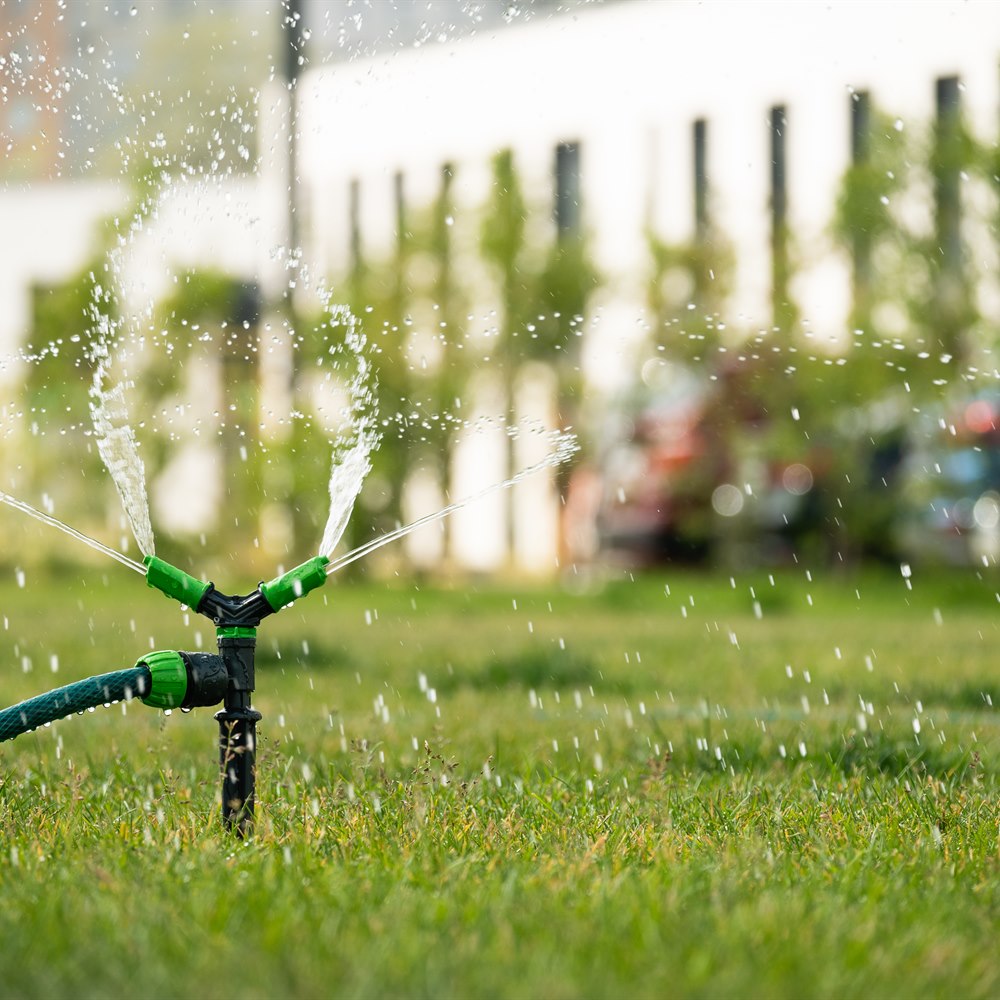
Persistent dry patches in an otherwise green lawn mean a head is not doing its job. Run the affected zone and walk to the dry area. Look for a head that is not rotating, not popping up fully, misting in one direction only, pointed the wrong way after being knocked, buried under accumulated mulch, or missing entirely after being struck by a mower.
A single failed head is the most common cause. Nozzle cleaning, by removing and rinsing the nozzle, fixes a partial clog. Soil settling that has buried a head below grade is fixed by pulling the riser and re-leveling at grade. A cracked body or bent riser means replacement. Persistent gaps in a zone where every head appears to be working normally usually indicate head spacing that was never adequate for the area, which is a design problem rather than a repair.
Wet Spots and Puddles
Areas that stay wet between irrigation cycles indicate a leak: a supply pipe, a valve that is not closing fully, or a cracked head body. A broken head at grade often produces a wet circle around it. Run each zone and look for water standing or bubbling at the surface to locate the problem.
To confirm a leak, shut off all water use in the house and watch the water meter dial. Movement when nothing is running and no irrigation is scheduled means water is escaping somewhere. Broken heads are a straightforward replacement. A valve stuck open or weeping needs the valve serviced or replaced. A cracked pipe requires excavation.
Pressure Problems
Heads that do not fully extend indicate insufficient pressure. Heads that mist instead of throwing a clear stream indicate either excessive pressure, often from too many heads on one zone, or a clogged nozzle.
When the symptom spans multiple zones, look at the main supply rather than the heads: a partially closed main shutoff valve, a failing pressure regulator, a leak in the main line, or seasonal low municipal pressure during peak demand. Confirm the main shutoff is fully open first, since that costs nothing to check. Pressure problems that persist across zones generally need professional diagnosis, because the fix is often a design correction rather than a part swap. (For more on this, see Sprinkler System Design: How Many Zones Do You Need?.)
Problems With Zones, Valves, and Controllers
A Zone Will Not Turn On
Three causes account for most of these: a failed solenoid, which is the electrical actuator on the valve, a wiring problem between controller and valve, or a controller programming error. Start at the controller and confirm the zone is programmed correctly and the unit has power.
Then test the valve directly at the valve box. Most solenoid valves have a manual override, a small bleed screw or lever, that opens the valve without an electrical signal. If the zone runs when opened manually but not from the controller, the problem is the wiring or the controller output. If it will not run even manually, the valve itself needs service. Solenoid replacement is a straightforward repair; wiring diagnosis is more involved.
A Zone Will Not Shut Off
A zone that runs continuously usually has a stuck valve. The rubber diaphragm that opens and closes the flow may be obstructed by debris, worn, or torn. Briefly opening the valve fully sometimes flushes the obstruction through and resolves it. If flushing does not help, the diaphragm needs replacement, which in most cases is a component repair rather than a full valve replacement.
To isolate the cause, disconnect the solenoid wire at the valve while the zone is running. If the zone closes when power is cut, the solenoid is stuck and needs cleaning or replacement rather than the valve body.
Controller Programming and Failures
The most common non-mechanical problem is simply incorrect programming: watering at the wrong time, for the wrong duration, on the wrong days, or with a seasonal adjustment factor carried over from the previous season. Review and reset the controller each spring. A power outage can reset some timers to default or off entirely.
Hardware fails too. A zone that never runs despite correct programming may have a failed controller output terminal. Controllers have finite lifespans, and an older unit showing problems across several zones is usually due for replacement rather than repair.
What Sprinkler Repairs Cost
| Repair | Typical cost |
|---|---|
| Sprinkler head replacement | $8 to $25 per head |
| Service call labor | $50 to $100 |
| Valve replacement | $200 to $500 installed |
| Pipe leak excavation and repair | $100 to $400 |
Cost figures on this page were checked against published pricing on August 29, 2026. How we source cost data.
Pipe repair varies with location and depth, which is why the range is wide. A head that costs $8 to $25 as a part still carries the $50 to $100 service call when a technician does the work, so bundling several small repairs into one visit is worth doing.
What You Can Fix and When to Call a Pro
Single head replacement, nozzle cleaning, head adjustment, and controller programming are DIY-feasible. Rotary rotor heads have a small adjustment screw, usually needing a flat screwdriver or the manufacturer’s tool, that sets the arc of rotation. Fixed spray heads use interchangeable nozzles for 180-degree, 90-degree, full-circle, and strip patterns. Adjusting head direction and arc is part of a normal spring startup.
Call a professional for valve replacement unless you have plumbing experience, for any pipe leak, for pressure problems affecting multiple zones, and for a system that does not respond to the controller at all, which is an electrical diagnosis. Annual startup and winterization are worth having done professionally for the inspection quality alone. (For more on this, see Sprinkler System Troubleshooting: Common Problems.)
When you hire, get two or three quotes so you can compare scope rather than just price, verify current general liability insurance and workers compensation coverage before work starts, and get the scope in writing. For any project over $500, written scope covering materials, labor, timeline, and warranty terms is non-negotiable, and a contractor who demands full payment upfront is a red flag in any trade.
Frequently Asked Questions
A failed or misaligned head in that zone. Run the zone and walk to the dry area, looking for a head that is not rotating, not popping up, misting in one direction, buried under mulch, or missing entirely. Single head failures are the most common cause of localized dry spots.
Head replacement runs $8 to $25 per head plus $50 to $100 in labor for a service call. Valve replacement is $50 to $150. A pipe leak requiring excavation and repair runs $100 to $400 depending on location and depth. Bundling small repairs into one visit avoids paying the service call twice.
Usually a failed solenoid, a wiring problem between controller and valve, or a controller programming error. Check the controller first, then use the valve's manual override at the valve box. If the zone runs manually but not from the controller, the wiring or controller output is at fault; if it will not run manually, the valve needs service.
Usually a stuck valve whose rubber diaphragm is obstructed by debris, worn, or torn. Briefly opening the valve fully sometimes flushes the debris through. If it still will not close, the diaphragm needs replacement, which is a component repair rather than a full valve replacement in most cases.
A leaking head, a cracked pipe, or a valve weeping when closed. A broken head at grade often leaves a wet circle around it. To confirm a leak, shut off all water in the house and watch the meter: movement with nothing running means water is escaping. Broken heads are simple replacements; cracked pipes require excavation.
Systemwide low pressure points to the main supply rather than individual zones: a partially closed main shutoff valve, a failing pressure regulator, a leak in the main line, or seasonal low municipal pressure during peak demand. Confirm the main shutoff is fully open first, then check whether every zone is affected.
Yes. A zone valve stuck open runs water continuously instead of only during scheduled cycles, a broken head sprays at full pressure and wastes significant water per cycle, and excessive programmed run times waste water every cycle. A smart controller with flow monitoring detects these conditions and alerts you automatically.
Rotary rotor heads have a small adjustment screw, usually requiring a flat screwdriver or the manufacturer's tool, that sets the arc of rotation. Fixed spray heads use interchangeable nozzles for 180-degree, 90-degree, full-circle, and strip patterns. Adjusting head direction and arc is part of the annual spring startup.